
From Star Trek to AI: When Tools Finally Catch Up with How We Think
Apr 22, 2026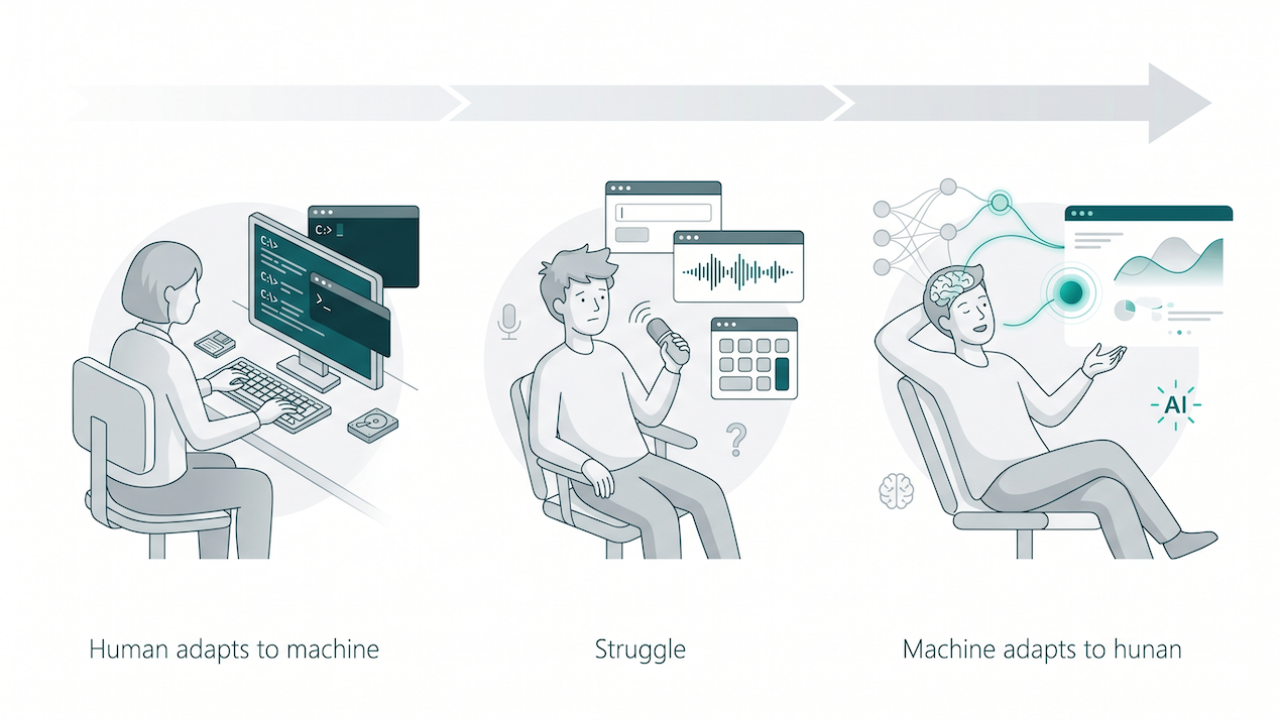
As a kid, I was fascinated by Star Trek.
Not because of the spaceships or the aliens, but because of something much simpler: people talking to computers. Asking questions. Giving commands. Getting answers instantly.
It opened a vision of the future where technology would no longer be something we operate, but something we naturally interact with.
When the idea was right, but the timing was not
Fast forward to the late 90s, when I joined a speech technology company and experienced voice recognition for the first time.
It was not quite Star Trek.
Yes, I could dictate text instead of typing. But as a fast typer, I quickly realised something:
dictating and thinking are not the same thing.
Typing allowed me to structure my thoughts as I went. Dictation forced me to think first, speak second.
The friction was real.
Great idea. Wrong moment.
And looking back, that gap tells us something important about innovation.
The technology worked. But the interaction did not fit how people naturally think.
Especially for people with a technical background, and I include myself here, there is often a hidden assumption: if the tool works, the problem is solved.
But in reality, a tool can be technically impressive and still fail in practice because it introduces too much friction in how people express, think, and work. This is also closely related to how many innovation ideas feel strong early on, but still remain fragile in practice, something we explore in more detail in why innovation ideas are weaker than they look.
That is one of the quiet reasons why many promising innovations stall early. Not because the idea is wrong, but because the experience is not aligned with human behaviour.
From adapting to machines to adapting machines to us
Two decades later, voice made a comeback. Not in how we think, but in how we act.
Voice commands on my phone. Voice commands in my car. Smart speakers at home.
Suddenly, voice worked, but in a very specific way: for doing, not for thinking.
Calling a contact. Setting navigation. Turning lights on or off. Selecting a mood or colour.
Practical. Useful. But still far from that original vision.
And there was still friction.
I often had to adapt to the system. Adjust my wording. Even tweak my pronunciation to match what the voice engine expected.
The machine did not adapt to me.
I adapted to the machine.
The real shift: when expression catches up with thought
Recently, something changed again.
With the rise of AI and LLMs, I noticed a new bottleneck in my own work.
Not the ideas. Not the tools.
My typing speed.
At first, I spent time correcting typos, refining sentences, polishing prompts. Until I realised something simple:
the system understood my intent anyway.
That shift towards intent over structure also links to a fundamental principle in innovation: defining value and meaning before jumping to structured solutions, as explained in defining value before defining solutions.
That was the first shift.
The second came when I started experimenting with voice again, this time combined with AI.
Tools like Wispr Flow do not just transcribe. They convert hesitant, unstructured speech into clean, readable sentences. They remove the “ums,” smooth out phrasing, and capture intent far better than older systems ever could.
And something surprising happened.
For the first time, I could think while speaking, and still end up with a structured result.
Typing → structure while thinking
Dictation → think before speaking
AI voice → think while speaking
For the first time, expression caught up with thought.
That changes everything.
Where technology shows its true potential
As a small experiment, I pushed the system a bit further.
Being used to working in Dutch, English, and French, I deliberately switched languages mid-sentence, something many Belgians naturally do.
In the past, that would completely break the system. You had to choose one language, stick to it, and adapt your behaviour accordingly.
Now?
It handled it surprisingly well.
It felt like breaking the rules on purpose, just to see what happens. And that is often where the most interesting insights appear.
Because this is not just a feature.
It is a reminder of something fundamental in innovation:
real progress does not live in the average use case. It emerges at the edges.
Interestingly, many collaboration failures also come from assuming shared understanding in “average” situations, while real differences only surface at the edges, a pattern we explore in common failure patterns.
If you want to understand what a technology can truly do, do not test it in ideal conditions. Test it in:
- messy reality
- mixed contexts
- edge cases and boundary conditions
That is where expectations are shaped.
That is where opportunities become visible.
That is where limitations become real.
Too many innovation efforts are evaluated in clean scenarios that do not reflect reality. The demo works. The pilot works. The presentation works.
But real life is ambiguous, multilingual, imperfect, and fast.
That is why boundary testing matters.
The deeper shift: from operating to collaborating
Here is the real shift behind all of this.
For decades, we have been in a mode of human-machine operating:
- we adapt to systems
- we follow their structure
- we translate our thinking into formats they can process
Now, we are entering a new phase:
human-machine collaboration
Human-machine operating → adapting to the tool
Human-machine collaboration → the tool adapts to you
We did not just improve voice technology.
We changed the relationship between humans and machines.
This mirrors a broader shift in innovation projects themselves, from contribution-based setups to true collaboration, something we detail in three ways organisations work together.
Instead of forcing our thinking into the tool, the tool starts adapting to how we think:
- it tolerates imperfection
- it interprets intent
- it smooths out expression
- it reduces friction between idea and output
Why this matters for innovation and collaboration
In most innovation projects, the biggest bottleneck is not technology.
It is friction.
- friction in expressing ideas
- friction in aligning perspectives
- friction in communicating across disciplines and languages
Reducing this type of friction is at the heart of effective collaboration design, especially when different communication styles come into play under pressure, as described in interaction styles under pressure.
When that friction drops, something changes.
Less friction in expression means more speed in collaboration.
Collaboration speeds up.
Iteration accelerates.
Ideas flow more freely.
And maybe even more importantly:
it changes how people feel in collaboration.
When expressing ideas becomes easier, hesitation drops. People speak up faster. Share earlier. Engage more naturally.
And that is often where real collaboration begins.
This is not just about convenience.
It is about speed. And in fast-changing environments, speed becomes advantage.
Teams that can express, iterate, and align faster will simply move ahead faster. That difference compounds quickly, and it directly translates into better outcomes and growth.
Three reflections for your own innovation projects
If you want to translate this into impact, here are three simple but powerful questions:
1. Tool friction
Where are your teams still adapting to the tool instead of the other way around?
2. Boundary testing
Are you exploring edge cases, or staying in safe, ideal scenarios?
This also connects to how hidden assumptions shape decisions and derail projects when left unchallenged, something we explain in hidden assumptions are the silent weakness of innovation concepts.
3. Speed of thought
What would change if expressing ideas became almost frictionless?
Because this is not just about making things easier.
It is about unlocking a different level of collaboration and performance.
From decades of experimentation to a new paradigm
Looking back, I have been experimenting with voice technology for decades.
Most of the time, it did not live up to the promise.
And that is exactly the point.
Innovation is rarely a straight line. Early experiences often disappoint, not because the idea is wrong, but because the timing is not right yet.
The real skill is recognising when things shift. When a technology finally aligns with how people naturally think and work.
In my work with companies, researchers, and innovation teams, I see this again and again.
Breakthroughs do not come from adopting new tools alone.
They come from rethinking how people collaborate when those tools remove friction.
That is what Win-Winnovation is about: designing collaboration environments where ideas do not get stuck in translation, but flow into results and growth.
Closing reflection
Take a moment to imagine your current projects.
What would they look like if ideas could flow as fast as they emerge?
If language, structure, and tools no longer slowed things down?
Not perfect. But fluid. Continuous. Almost conversational.
We have been trying to talk to computers for decades.
Now that they are starting to understand us, the real question is no longer technological.
This is not a tool shift. It is a collaboration shift.
If this resonates with your own innovation challenges and you want to translate it into a practical approach, you can contact me through the contact page.
If you want to dive deeper, I’ve captured these ideas across a series of blog posts:
👉 Main article: From Star Trek to AI: When Tools Finally Catch Up with How We Think
👉 Why technology fails in practice
👉 When thinking becomes faster than typing
👉 Why innovation breaks in real life
👉 AI and the collaboration shift
Hey!

