
When Thinking Is Faster Than Typing: How AI Boosts Productivity
May 06, 2026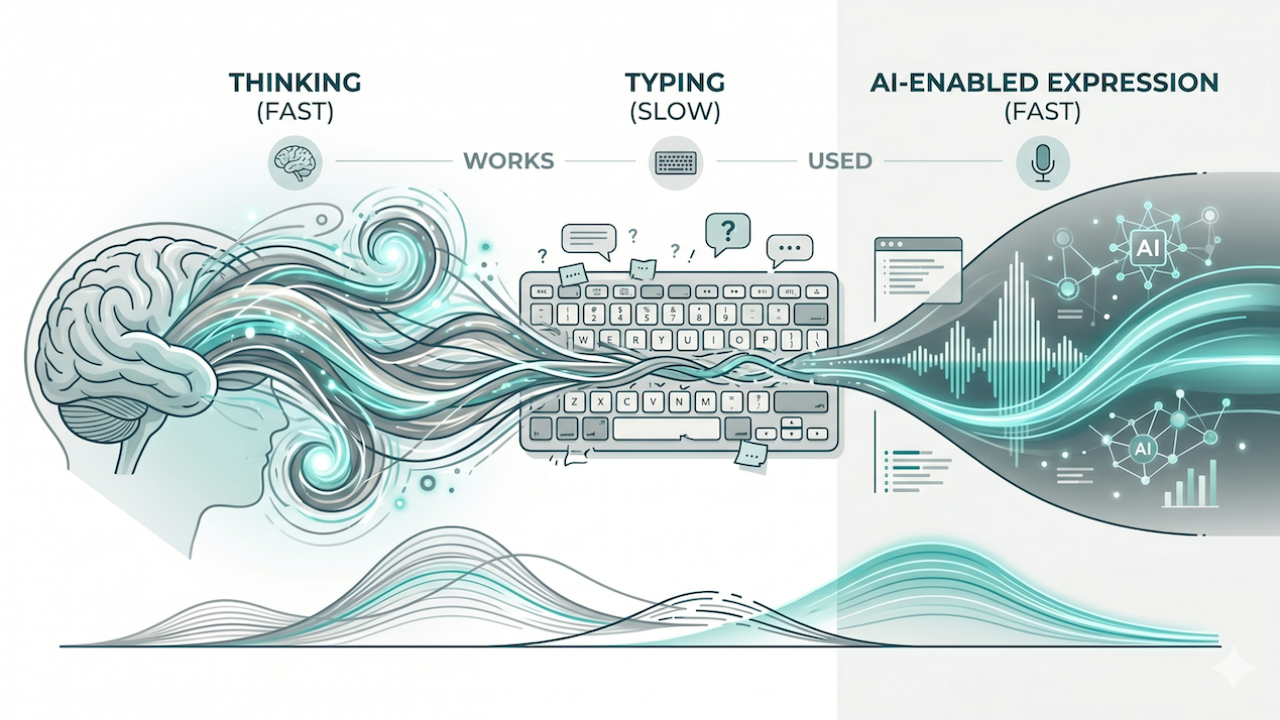
The bottleneck in my work was not ideas.
It was not tools.
It was my typing speed.
For a long time, I didn’t realise it. Like many people, I assumed productivity depended on better tools, better structure, or better planning.
But something subtle had changed.
My thinking had become faster than my ability to express it.
When expression becomes the constraint
In many knowledge-driven environments, especially in innovation projects where speed of iteration matters, we focus on generating ideas, analysing problems, and making decisions.
But there is a hidden layer in between:
expression
Turning thoughts into:
- text
- messages
- proposals
- structured input for tools
That step is often taken for granted.
Until it becomes the bottleneck.
Because even when ideas are clear in your mind, expressing them takes time. You type, correct, rephrase, structure.
And in that process, something happens:
- ideas lose momentum
- nuance disappears
- speed drops
Not because the thinking is weak.
But because the translation is slow.
The shift from precision to intent
For years, digital tools required precision.
You had to:
- write correctly
- structure clearly
- formulate input in a way the system could process
In other words:
you adapted to the tool
That is why typing felt natural. It allowed you to structure your thinking before committing it.
But it also slowed you down.
Because the system only understood what you expressed perfectly.
When the system understands anyway
With the rise of AI and large language models, something fundamental has changed.
The system no longer needs perfect input.
It understands intent.
That means:
- typos matter less
- incomplete sentences are still usable
- structure can emerge after expression
And that changes how you interact with technology.
Instead of thinking first and expressing second, the two can happen at the same time.
This shift towards intent over structure also connects to a broader innovation principle: focusing on value and meaning before defining structured solutions, as explored in defining value before defining solutions.
Voice as a thinking interface
This becomes even more visible when combining AI with voice.
Traditional dictation never really replaced typing for complex thinking.
Because it forced you into a sequence:
- think
- speak
- correct
That created friction.
But newer AI-driven voice tools behave differently.
They:
- interpret intent
- clean up speech
- structure output automatically
Which leads to a different experience entirely:
Typing → structure while thinking
Dictation → think before speaking
AI voice → think while speaking
For the first time, expression starts to keep up with thought.
Why this changes productivity in innovation teams
At first glance, this looks like a small efficiency gain.
Speak instead of type. Save some time.
But the real impact is deeper.
Because when expression becomes faster:
- ideas are captured earlier
- iteration cycles shorten
- communication becomes more fluid
And that compounds.
In innovation teams, this has direct consequences:
- discussions move faster
- feedback loops tighten
- alignment happens earlier
Not because people work harder.
But because less energy is lost in translation.
From individual efficiency to team impact
What starts as a personal productivity shift quickly becomes a team dynamic.
When expressing ideas becomes easier:
- people contribute sooner
- half-formed ideas are shared earlier
- collaboration becomes more iterative
That changes the rhythm of innovation projects.
Instead of waiting for polished input, teams work with evolving ideas.
And that accelerates progress.
If you want to explore how this shift connects to broader changes in collaboration and innovation, you can read the full perspective here:
👉 From Star Trek to AI: When Tools Finally Catch Up with How We Think
The new question for innovation teams
This shift raises an important question.
Not:
How do we improve our tools?
But:
How do we reduce friction in expressing ideas?
Because in practice, many delays in innovation are not caused by lack of insight.
They are caused by:
- slow communication
- delayed articulation
- over-structuring too early
And those are exactly the areas where AI is now making a difference.
Three reflections for your own work
If you recognise this pattern, here are three questions worth exploring:
1. Where is expression slowing you down?
In which parts of your work does translating thoughts into output take more time than the thinking itself?
2. How early do ideas get shared?
Are people waiting until things are fully structured, or is there space for early input?
3. What would change if expression became frictionless?
How would your speed of iteration and collaboration evolve?
From faster typing to faster thinking
For years, productivity improvements focused on doing things faster.
Faster typing. Faster tools. Faster processing.
But this is different.
This is about removing a layer of friction between thinking and doing.
And when that layer disappears, something interesting happens.
Ideas do not just move faster.
They move more naturally.
When expression catches up with thought, productivity becomes flow.
Closing reflection
Take a moment to reflect on your own work.
Where are you still translating your thoughts into formats that slow you down?
And what would change if that translation step became almost invisible?
Not perfect. But fluid.
Because that is where productivity shifts from effort to flow, and where innovation starts to accelerate into real results and growth.
If this resonates with your own way of working and you want to explore how to translate it into your context, you can contact me through the contact page.
If you want to dive deeper, I’ve captured these ideas across a series of blog posts:
👉 Main article: From Star Trek to AI: When Tools Finally Catch Up with How We Think
👉 Why technology fails in practice
👉 When thinking becomes faster than typing
👉 Why innovation breaks in real life
👉 AI and the collaboration shift
Hey!

