
AI Is Not the Real Shift. Collaboration Is
May 20, 2026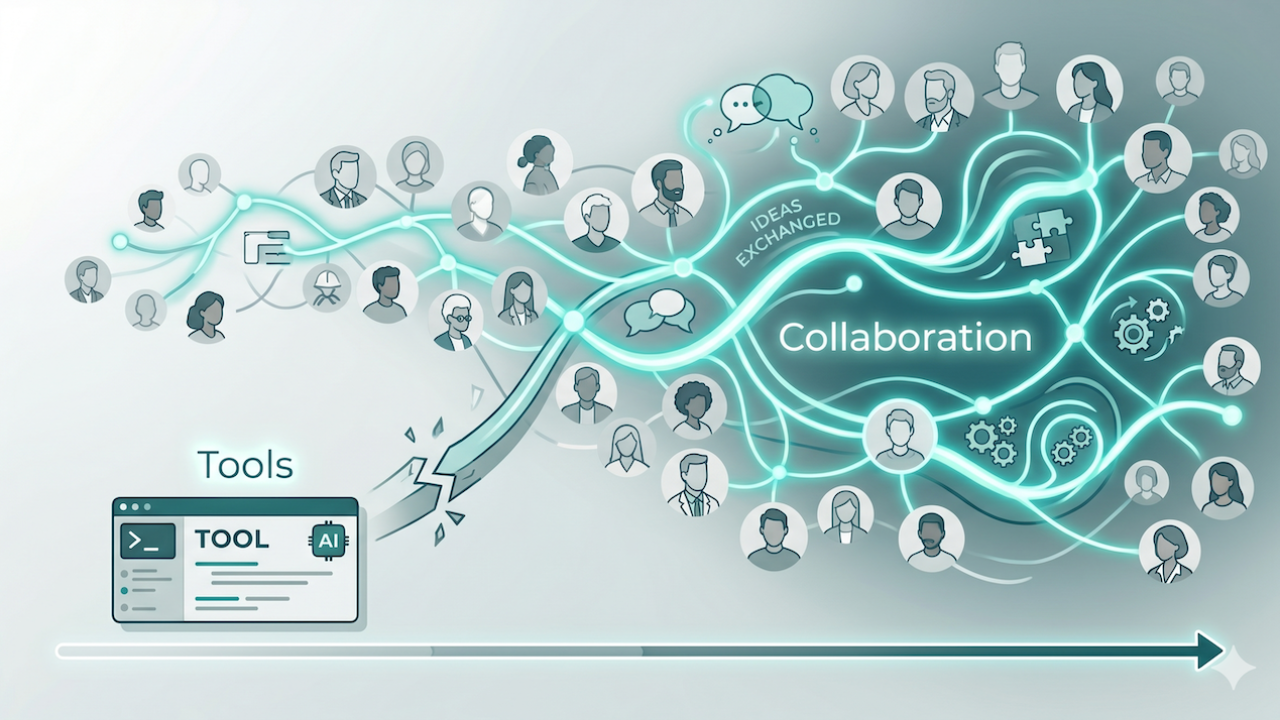
Everyone is talking about AI tools.
Faster writing. Better summaries. Smarter automation.
And yes, these tools are impressive.
But focusing only on the tools misses the real shift.
Because what is changing is not just what we can do.
It is how we collaborate.
From operating tools to collaborating with them
For decades, we have interacted with technology in a very specific way.
We operated it.
We adapted to:
- interfaces
- structures
- predefined workflows
We translated our thinking into formats the system could understand.
That worked.
But it came with a cost.
Every translation step introduced friction.
The invisible cost of friction
In most innovation projects, especially in innovation teams working across disciplines and organisations, the biggest bottleneck is not a lack of ideas or capability.
It is friction.
- friction in expressing ideas
- friction in aligning perspectives
- friction in communicating across disciplines
And this friction is rarely visible at first.
It appears in:
- delayed discussions
- misunderstandings
- slow decision-making
- repeated clarification
Not because people are not capable.
But because expressing and aligning ideas takes effort.
What AI is actually changing in collaboration
AI tools are often described as productivity enhancers.
But their deeper impact is different.
They reduce friction in expression.
They:
- interpret intent instead of requiring perfect input
- tolerate ambiguity
- help structure ideas after they are expressed
Which means something fundamental shifts.
Instead of adapting to the tool, the tool starts adapting to us.
A different kind of collaboration
This shift has a direct impact on how people work together.
When expressing ideas becomes easier:
- people share earlier
- discussions become more iterative
- alignment happens faster
Instead of waiting for fully structured input, teams can work with evolving ideas.
That changes the dynamic.
Collaboration becomes less about delivering polished contributions.
And more about co-creating in real time.
This reflects a broader distinction in innovation projects between contributing and truly collaborating, something explored further in three ways organisations work together.
Why this matters for innovation teams
In innovation teams, and especially in complex innovation projects where alignment is critical, speed is not just about execution.
It is about alignment.
How quickly can you:
- express an idea
- get feedback
- adjust direction
If each of these steps is slowed down by friction, the entire process slows down.
But when friction drops:
- iteration cycles shorten
- decisions happen earlier
- momentum builds
And that creates a compounding effect.
Teams that align faster move faster.
The role of communication under pressure
As collaboration accelerates, another challenge becomes more visible.
Differences in how people communicate.
Under pressure:
- some focus on facts
- others focus on relationships
- others focus on action
If these differences are not understood, faster communication can actually increase misalignment.
That is why reducing friction in tools is only part of the equation.
Understanding how people interact is equally important, especially in complex environments, as described in interaction styles under pressure.
From tools to systems of collaboration
The real opportunity is not to optimise individual tools.
It is to rethink the system in which collaboration happens.
That includes:
- how ideas are captured
- how they are shared
- how feedback is integrated
- how decisions are made
AI becomes part of that system.
Not as a standalone solution.
But as an enabler of smoother interaction.
The real shift
This is why the current wave of AI is different from previous technological advances.
It is not just improving what we do.
It is changing how we work together.
From:
- operating systems
- delivering structured input
- adapting to rigid processes
To:
- interacting naturally
- sharing ideas fluidly
- co-creating in real time
This is not a tool shift. It is a collaboration shift.
What this means in practice
If you want to leverage this shift, the question is not:
Which AI tool should we use?
But:
How do we design collaboration with less friction?
That means looking at:
- where ideas get stuck
- where communication slows down
- where alignment takes too long
And asking how these points can be improved.
If you want to explore how this broader shift plays out across innovation and collaboration, you can read the full perspective here:
👉 From Star Trek to AI: When Tools Finally Catch Up with How We Think
Three reflections for your organisation
If you are working on innovation, here are three questions to consider:
1. Where are you still operating tools?
Where do people need to adapt to systems instead of the other way around?
2. Where does collaboration slow down?
At which points do ideas lose speed or clarity?
3. What would change if interaction became more natural?
How would that affect your ability to align and move forward?
From better tools to better outcomes
Better tools do not automatically lead to better outcomes.
Better collaboration does.
When friction drops:
- people engage earlier
- ideas evolve faster
- alignment improves
And that is where innovation starts to deliver real results and growth.
Closing reflection
Take a moment to reflect on your current way of working.
Where are you still focused on improving tools, instead of improving collaboration?
And what would change if you shifted that focus?
Because the real opportunity is not just to work faster.
It is to work better together.
If this resonates with your own innovation challenges and you want to translate it into a practical approach, you can contact me through the contact page.
If you want to dive deeper, I’ve captured these ideas across a series of blog posts:
👉 Main article: From Star Trek to AI: When Tools Finally Catch Up with How We Think
👉 Why technology fails in practice
👉 When thinking becomes faster than typing
👉 Why innovation breaks in real life
👉 AI and the collaboration shift
Hey!

