
Why Good Technology Fails in Practice (Even When It Works)
Apr 29, 2026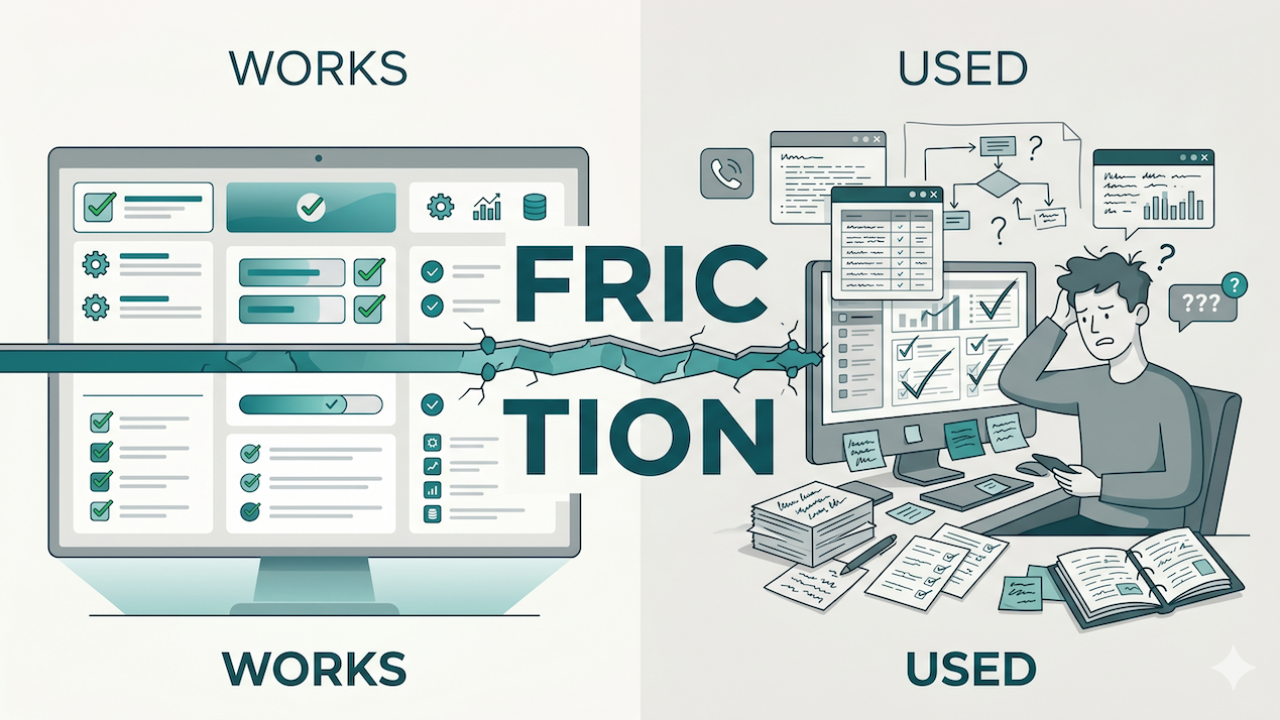
“If the technology works, the problem is solved.”
It sounds logical. Especially if you come from an engineering or research background.
And yet, this assumption quietly undermines a surprising number of innovation projects.
Because in practice, many technologies work perfectly… and still fail.
When “working” is not enough
I’ve seen this pattern repeatedly, especially in innovation projects where expectations are high and adoption is critical.
A solution is technically sound. The performance is there. The system does what it is supposed to do.
On paper, everything checks out.
And still, adoption is slow. Users hesitate. Teams revert to old habits. The expected impact never fully materialises.
At that point, the typical reaction is to look for technical issues. Improve performance. Add features. Refine the solution.
But often, the real issue is not in the technology itself.
It is in how people experience it.
The hidden gap: thinking vs using
Technology does not operate in isolation. It interacts with how people think, decide, and act.
And that is where things start to break.
A tool can be powerful, but if it forces users to:
- rethink their natural workflow
- translate their thoughts into unnatural formats
- slow down to interact correctly
then friction appears.
And friction changes behaviour.
People hesitate. They postpone. They simplify. Or they stop using the tool altogether.
Not because they reject the idea.
But because the effort to use it outweighs the perceived benefit.
A familiar blind spot
This is particularly common in technical environments.
When you are close to the technology, it is easy to assume that solving the technical problem is the core challenge.
Once that is done, the rest will follow.
But that assumption hides a deeper issue.
Innovation is not just about solving problems. It is about fitting into real-life contexts where people think, act, and collaborate in imperfect ways.
This is also why many ideas feel strong in the beginning, but later struggle to create impact in practice. What looks convincing in theory can still be fragile in real use, something explored further in why innovation ideas are weaker than they look.
Friction is the real bottleneck
In many innovation projects, the real bottleneck is not capability.
It is friction.
- friction in understanding
- friction in using
- friction in integrating into daily work
And friction is subtle.
It rarely shows up in early demos or controlled pilots. Everything works when the environment is clean, expectations are aligned, and users are focused.
But in reality, people:
- multitask
- switch contexts
- interpret things differently
- operate under time pressure
That is where friction becomes visible.
And that is where many “working” solutions start to struggle.
From technical success to real adoption in innovation projects
If you want a solution to succeed in practice, the question shifts.
Not:
Does it work?
But:
Does it fit how people naturally think and work?
That requires a different lens.
It means looking beyond functionality and focusing on:
- how easily ideas can be expressed through the tool
- how intuitively people can interact with it
- how well it integrates into existing collaboration dynamics
Because in the end, adoption is not a technical decision.
It is a behavioural one.
A broader shift is happening
Interestingly, this gap between technical capability and real use is starting to close.
New generations of AI tools are no longer just processing input. They are interpreting intent.
They tolerate imperfection. They adapt to how people express themselves. They reduce the need for rigid structure.
And that changes the equation.
Instead of forcing people to adapt to the tool, the tool starts adapting to people.
That shift has implications far beyond usability.
It affects how quickly ideas can be expressed, shared, and refined within teams. It reduces friction in collaboration and accelerates iteration.
And that is where real impact starts to appear.
If you want to explore how this shift plays out more broadly in innovation and collaboration, you can read the full perspective here:
👉 From Star Trek to AI: When Tools Finally Catch Up with How We Think
Three questions to reflect on
If you are working on innovation projects, it is worth pausing on a few simple questions:
1. Where does friction still exist?
Where do users need to adapt their thinking or behaviour to make the tool work?
2. What happens outside the ideal scenario?
Have you tested the solution in real-life conditions, or only in controlled environments?
3. Are you solving the right problem?
Are you improving the technology, or improving how people can actually use it?
From working solutions to real impact
The difference between a working solution and a successful one is often smaller than it seems.
It is not about adding more features or increasing performance.
It is about reducing friction.
When friction drops:
- adoption increases
- collaboration improves
- ideas move faster
And that is where innovation starts to translate into real results and growth.
Working technology is not enough. What matters is whether people can actually use it.
If you recognise this pattern in your own projects and want to work on it, you can reach out via the contact page. I am glad to share ideas and examples.
If you want to dive deeper, I’ve captured these ideas across a series of blog posts:
👉 Main article: From Star Trek to AI: When Tools Finally Catch Up with How We Think
👉 Why technology fails in practice
👉 When thinking becomes faster than typing
👉 Why innovation breaks in real life
👉 AI and the collaboration shift
Hey!

