
Light Governance Helps Innovation Partnerships Survive
Aug 18, 2026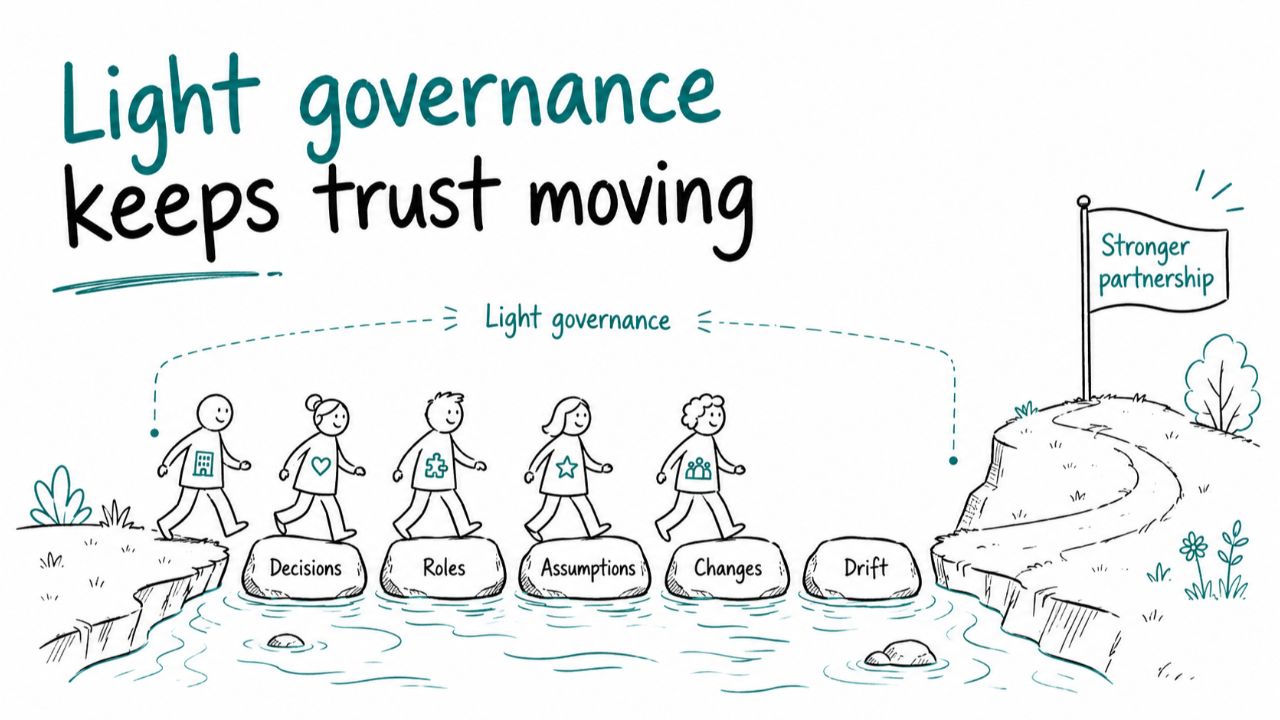
Most innovation partnerships do not fail on the first day.
They start with energy, ambition, and good intentions. The idea feels promising. The partners see potential. Everyone wants the collaboration to work.
The real test comes later.
Assumptions surface. Decisions slow down. Priorities shift. People change roles. Partners discover that they did not all mean the same thing when they talked about a pilot, a prototype, a result, a market opportunity, or a shared ambition.
That is usually the moment when someone says:
We need better governance.
And often, people hear:
More meetings.
More reporting.
More documents.
More control.
More overhead.
That is not what good governance should mean.
In collaborative innovation, innovation governance is not about controlling every detail. It is about creating the lightest useful structure that helps partners make decisions, surface assumptions, handle changes, and keep trust intact when uncertainty appears.
Good governance is not about adding weight.
It is about removing friction.
In brief
Light innovation governance helps partnerships survive the messy middle of collaboration. It gives partners enough structure to make decisions, surface assumptions, handle changes, and correct drift without turning the project into a bureaucratic machine.
Light governance also helps partnerships move faster, because partners spend less time renegotiating how they work together.
Leader takeaway: governance is not the opposite of trust. It is what helps trust survive when innovation becomes uncertain, complex, and real.
Governance is not bureaucracy
Governance has a reputation problem.
Many people associate it with heavy procedures, formal committees, endless reporting, and slow decision-making. That reputation is not entirely unfair. In some organisations, governance really does become a machine that creates work without creating clarity.
Nobody starts an innovation partnership because they dream of a steering committee.
But that is bad governance.
Good governance is more practical.
It answers the questions that otherwise keep returning: who can decide what, how changes are handled, how concerns are raised early, and what partners do when momentum starts to drop.
These questions are not administrative details. They shape whether partners can keep moving when the project becomes more complex than expected.
Without answers, every difficult moment becomes a new negotiation.
With light governance, partners do not have to reinvent the collaboration every time reality changes.
Ideally, the most important governance principles are sealed in a contract or consortium agreement. That gives partners a formal reference when ownership, responsibilities, decision rights, confidentiality, or use of results become sensitive.
But governance does not only matter when lawyers are involved.
Even in lighter collaborations without formal legal documents, writing the principles down already creates value. A short shared note, decision page, or lightweight collaboration agreement can help partners stay on the same page. It gives them something concrete to return to when memories differ, assumptions shift, or the project starts moving faster than expected.
Minimum viable governance
Innovation teams often talk about minimum viable products. In partnerships, we also need minimum viable governance.
That does not mean weak governance. It means governance that is light enough to use and clear enough to help.
If governance is too heavy, people bypass it.
If governance is too vague, people improvise.
If governance is just right, people use it without feeling slowed down.
Minimum viable governance defines the few agreements that keep the collaboration workable:
- Who decides what
- How decisions are recorded
- When partners need to be consulted
- How changes are handled
- What information can be shared
- How concerns can be raised early
- What happens when engagement drops
That may sound simple, but it prevents a lot of avoidable friction.
Sometimes this requires a steering group. Sometimes it only requires a clear decision rhythm, a shared decision log, and the habit of making assumptions explicit.
The goal is not to build the perfect governance model.
The goal is to build the simplest structure that helps partners keep collaborating.
Why trust alone is not enough
Trust is essential in innovation partnerships.
But trust without clarity is fragile.
At the start of a collaboration, partners often trust each other because the ambition feels shared. They like the idea. They like the people. They believe the project can create value.
But each partner may still be working with different assumptions.
One partner sees a meeting note as input for discussion. Another sees it as a decision. One partner thinks a pilot means a small learning experiment. Another sees it as a first step towards market launch. One partner assumes the project is exploratory. Another already frames it as a pre-commercial route.
Nobody is necessarily wrong.
But if these assumptions remain implicit, trust starts carrying too much weight.
That is risky.
Good governance does not replace trust. It protects trust by making assumptions visible before they become personal disappointments.
Governance is not the opposite of trust. It is what helps trust survive.
Formal and informal governance both matter
In innovation partnerships, governance is not only what is written in the contract.
Formal governance matters, of course. Contracts, consortium agreements, decision rights, intellectual property arrangements, communication rules, and escalation paths all have their place.
Where the stakes are high, these principles should be sealed formally. That gives the collaboration a stronger foundation and prevents difficult discussions from depending only on goodwill or memory.
For a broader view on the role of structure, roles, and decision-making, this connects directly to governance in innovation collaborations.
But formal governance is only part of the story.
Informal governance often determines how the collaboration really works.
Who speaks up when something feels wrong?
Who influences decisions behind the scenes?
Is silence interpreted as agreement?
Can junior people raise concerns?
Do partners share doubts early, or only when the situation has already become difficult?
Do people feel safe enough to say: “I think we are drifting”?
A partnership can have strong formal governance and still fail because informal governance is weak.
The opposite is also true. A partnership with a limited formal structure can work surprisingly well when people have clear habits, honest communication, and a shared rhythm for decisions.
The best partnerships pay attention to both.
They make the formal rules clear enough, and they build the informal habits that keep the rules alive.
Governance should fit the partners
Good governance is not one-size-fits-all.
A collaboration between two SMEs does not need the same structure as a publicly funded research consortium with ten partners. A corporate-startup collaboration does not need the same rhythm as an academic-industry project. A sector-wide initiative does not need the same decision logic as a bilateral proof of concept.
The governance should fit the partnership.
For SMEs, light governance is not about copying corporate procedures. It is about avoiding the expensive confusion that appears when roles, decisions, and expectations stay implicit.
For corporates, governance helps innovation teams translate partnership decisions into internal approval, legal review, budget logic, and scaling pathways without restarting the discussion every time.
For researchers, governance creates clarity on publication, contribution, timing, and industry expectations, so scientific value and business relevance do not have to compete unnecessarily.
Good governance does not force everyone into the same operating logic.
It makes the different operating logics visible.
That is where collaboration becomes more realistic. Partners do not have to pretend they work in the same way. They only need enough clarity to work together.
Governance helps decisions move
One of the most common causes of frustration in innovation partnerships is decision delay.
Not because people are unwilling.
Often, it is unclear who can decide.
A project meeting may end with apparent agreement. Then someone needs to check internally. Another partner needs approval from management. A researcher needs to verify publication implications. A corporate partner needs legal review. An SME needs to understand the cost impact.
Again, nobody is necessarily wrong.
But without a clear decision rhythm, the collaboration slows down.
Light governance helps by making decision paths explicit.
Some decisions need all partners.
Some decisions only need a work package group.
Some decisions need a business owner.
Some decisions need legal review.
Some decisions can be made by the operational team.
When this is clear, partners can move faster.
Governance does not slow down decisions. Poorly designed governance does. Good governance removes unnecessary waiting.
Governance helps assumptions surface early
Innovation projects are full of assumptions.
That is normal. In uncertain work, you never know everything at the start.
The problem is not that assumptions exist. The problem is that they stay hidden.
Assumptions can hide in simple words:
Prototype.
Pilot.
Validation.
Market-ready.
User test.
Open result.
Partner commitment.
Dissemination.
Ownership.
Each partner may use the same word and mean something different.
Light governance creates moments where assumptions are made explicit. Not through heavy procedures, but through simple habits:
- Restating decisions in plain language
- Asking what a term means for each partner
- Checking what has changed since the previous meeting
- Naming risks before they become issues
- Asking who needs to approve what internally
- Making “we assume that...” a normal sentence in the collaboration
This kind of governance is practical. It does not create bureaucracy. It creates shared understanding.
For a deeper view on this, the topic connects naturally to alignment by design.
Governance helps detect drift in innovation partnerships
Innovation partnerships rarely collapse in one dramatic moment.
More often, they drift.
A partner starts replying more slowly. A key person misses meetings. Contributions become thinner. Decisions are reopened. Side conversations increase. The same doubts return again and again. A partner keeps saying, “we need to check internally,” but no decision follows.
At first, these signals look small.
But together, they show that the collaboration is losing alignment.
Light governance helps detect drift before it becomes failure.
That does not require a complex dashboard. It can be as simple as regularly checking whether partners are still engaged, decisions are still moving, assumptions are still shared, and the collaboration still creates a meaningful win for everyone involved.
If the answer becomes unclear, the partnership needs attention.
Not blame. Attention.
This is where governance becomes a learning mechanism. It helps partners correct course before disengagement becomes irreversible.
For more on this pattern, this article connects directly to detecting and correcting drift.
Innovation governance should be designed before pressure appears
Many partnerships only discuss governance when something goes wrong.
That is too late.
When pressure appears, people defend positions. Small misunderstandings become personal. Legal language becomes sharper. Trust becomes more fragile.
It is much easier to agree on working rules while the relationship is still positive.
Before the project starts, or at least before it becomes operational, partners should agree on a few practical basics:
- How decisions are made and recorded
- How changes are handled
- How concerns are raised early
- How information and external communication are managed
- How partner engagement is followed
- How conflict is escalated without drama
Ideally, the key principles are translated into the contract, consortium agreement, or formal collaboration agreement. That is still the safest way to seal expectations when the stakes are high.
But governance does not only start when lawyers get involved. In lightweight collaborations, early-stage explorations, pilots, or small proof-of-concept projects, partners can already benefit from writing the principles down in plain language.
This does not need to be a heavy document.
It needs to be usable.
A short collaboration playbook, a shared decision note, a simple glossary, a meeting rhythm, and a clear escalation path may already be enough for many partnerships. The value is not in the format. The value is that partners have something concrete to point to when they need to check whether they are still on the same page.
The best governance is often almost invisible. Not because it is absent, but because it prevents confusion before people feel the friction.
The best governance creates room to think, not just rules to follow.
Five governance questions before the project starts
Before launching an innovation partnership, take a moment to define the light structure that will help the collaboration survive reality.
Start with five questions:
- 1. Who has the mandate to decide, and on what?
- 2. Which decisions need all partners, and which can be made by a smaller group?
- 3. How do we handle changes in scope, ambition, timing, or partner commitment?
- 4. How do we make assumptions explicit before they become conflicts?
- 5. Which early warning signals tell us that the collaboration is drifting?
These questions are simple, but they are powerful.
They help partners avoid unnecessary meetings, reduce repeated discussions, and keep the collaboration focused on progress.
They also help teams move from good intentions to practical collaboration.
Light governance keeps collaboration human
There is a human side to governance that is often underestimated.
When rules are unclear, people become cautious. They hesitate to speak. They protect their own position. They wait for others to move first. They start interpreting silence, delays, and vague answers.
That is not a good basis for collaborative innovation.
Light governance creates enough safety for people to contribute. It gives structure without suffocating initiative. It makes expectations visible without turning every conversation into a formal procedure.
It helps partners say:
This is what we decided.
This is what we still need to clarify.
This is what changed.
This is where I need help.
This is where I see risk.
This is where we may be drifting.
That is not bureaucracy.
That is collaboration hygiene.
The lightest structure that keeps trust alive
This mini-series started with a simple idea: collaborative innovation does not mean sharing everything. It means opening the right gates.
The second article looked at IP protection and value capture: protect what matters, share what enables collaboration, and choose the protection model that fits the route to value.
This third article brings the two together.
Once partners start working, openness and protection become practical questions. Who decides? Who can use what? What happens when assumptions change? How do we keep people engaged? How do we prevent silent drift?
That is where governance matters.
Not as a heavy control system.
But as the lightest useful structure, preferably written down and formally sealed when needed, that keeps trust alive when innovation becomes uncertain.
Done well, light governance helps partners move faster, reduce friction, protect relationships, and increase the chance that the partnership leads to stronger results and sustainable growth.
If you recognise that your innovation partnerships sometimes lose momentum because decisions, assumptions, or expectations remain unclear, you can reach out via the contact page. I am happy to explore what light, practical governance could look like in your context.
Hey!

