
Collaborative Innovation Does Not Mean Sharing Everything
Jul 06, 2026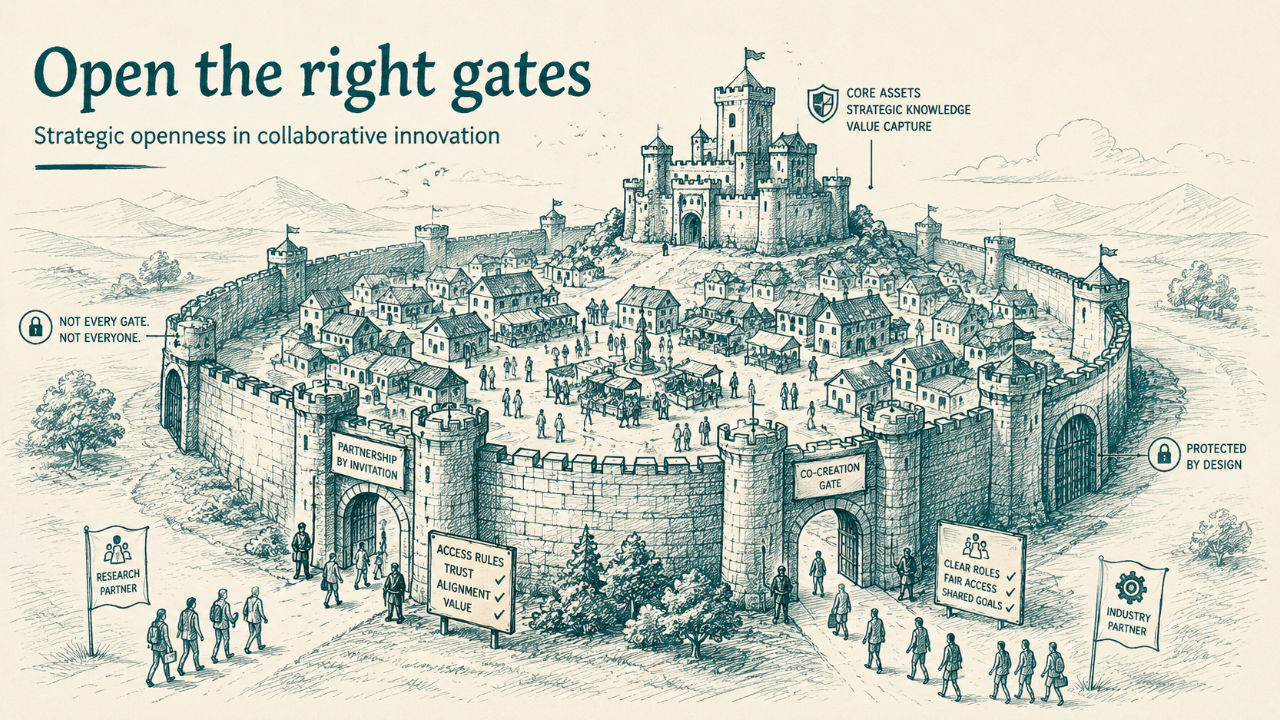
When company leaders consider innovation with external partners, one concern often appears very quickly:
What do we need to protect?
It is a very valid question.
Companies invest time, money, expertise, and risk into innovation. SMEs may depend on one critical technology, customer insight, or market position. Larger organisations often need to protect strategic assets across several business lines. Research partners, suppliers, customers, and ecosystem actors may each bring knowledge that is valuable in a different way.
So yes, protection matters, but so does openness
But for company leaders, this is not only a legal question. It is a strategic choice.
The way you design openness determines whether collaboration gives you access to new knowledge, faster validation, stronger concepts, and growth, or whether it creates confusion, hesitation, and value leakage.
Before asking what must be protected, ask what the business needs to win from the collaboration.
Many organisations still think in two extremes. Either innovation stays closed and everything remains inside the company, or collaboration means opening up too much and losing control.
That is a false choice.
A useful way to picture this is as a medieval city.
Some organisations keep all gates closed and protect everything inside the walls. Others open every gate and hope that trust will be enough. But the strongest cities were not the ones without gates, or the ones that opened every entrance to everyone. They were the ones that knew which gates to open, when, for whom, and under which rules.
That is also the essence of strong collaborative innovation.
It is not about opening everything.
It is about opening the right gates.

Collaborative innovation is not about opening every gate. It is about designing which gates should open, for whom, and under which conditions.
In brief
Collaborative innovation does not mean sharing everything. For company leaders, the real decision is what to open, what to protect, and how to align both with strategy. When openness is designed well, partners can contribute faster, value capture becomes clearer, and the collaboration has a better chance of delivering results and growth.
Leader takeaway: do not choose between closed and open. Choose the openness model that supports your strategy, protects what creates advantage, and gives partners enough room to help you move faster.
Closed innovation can feel safe, but it has a cost
Closed innovation can feel like the safest option. You protect what you know, limit access, control the perimeter, and reduce exposure.
In the city metaphor, everything valuable stays inside the walls. The gates are closed, the guards are alert, and outsiders are mainly seen as a possible risk.
There is value in this. Not every insight, technology, or early idea should be shared with every possible partner.
But there is also a cost.
When everything stays inside, you limit your access to external expertise, complementary knowledge, user insights, market signals, funding opportunities, and alternative ways of thinking. In a fast-moving innovation landscape, that can become a serious weakness.
Few organisations can master every relevant technology, market shift, user need, regulatory change, and business model on their own.
Closed innovation may protect your current position, but it can also reinforce your blind spots.
And blind spots are dangerous when markets move faster than internal teams can learn.
Naive openness is not a strategy
The opposite extreme is naive openness.
That is the version where all gates are open.
“Let’s share everything.”
“Let’s trust each other.”
“Let’s keep it flexible.”
“Agreements can come later.”
That may sound collaborative, but it is not a strategy. It is an invitation for confusion.
Naive openness can leave you in the worst possible position: you do the work, share the knowledge, help create the value, and still lack the rights, position, or agreements to capture that value afterwards.

From the outside, naive openness can look dynamic. There are many partners, many meetings, many ideas, and many conversations.
But activity is not the same as progress.
Many meetings, many partners, many ideas. Still no strategy.
When nobody knows who owns what, who can use which result, what can be published, what must remain confidential, and how value will be captured, the project becomes fragile.
Sooner or later, someone asks the difficult question:
Who captures the value?
And if that question has not been addressed early enough, trust can disappear very quickly.
closed innovation limits learning, naive openness weakens value capture. Strategic openness is the useful middle.
Strategic openness: opening the right gates
The stronger option sits between these two extremes.
Strategic openness is not closed innovation with a nicer name. It is also not naive openness with a few legal documents added at the end.
It is a deliberate way of designing how partners work together.
Strategic openness means you:
- Share what enables collaboration
- Protect what is strategically essential
- Define access rights early
- Clarify how value will be created
- Clarify how value can be captured
- Align openness with where your organisation wants to grow
It also gives people the confidence to contribute without wondering whether they are exposing too much or stepping outside the rules.
In the medieval city metaphor, this is not a city without walls. It is a city with gates, guards, agreements, trading rules, protected spaces, and public squares.
Some areas are open for exchange. Some areas require permission. Some assets stay protected. The point is not to remove the walls, but to design the access.
That is why strategic openness is a leadership choice.
It asks: which knowledge should we share so partners can contribute meaningfully? Which assets must stay protected because they create strategic advantage? Which conversations can be open? Which results need clear ownership? Which rights do we need afterwards to turn the collaboration into value?
These are not administrative details. They shape whether the collaboration can deliver real results.
Openness should follow strategy
A common mistake is to treat openness as a general attitude.
“We are open to collaboration.”
“We believe in open innovation.”
“We want to work with partners.”
That sounds positive, but it is not enough.
Openness only becomes useful when it is connected to strategy.
Where do you want to grow?
Which capabilities do you want to build?
Which markets do you want to enter?
Which risks do you want to reduce?
Which assets truly create advantage?
Which external knowledge could help you move faster?
Without that strategic lens, openness becomes vague. And vague openness creates weak collaboration.
Before deciding what to protect or share, it helps to clarify the value logic of the innovation itself. What value are you trying to create, for whom, and why does it matter? That connects naturally to defining value before defining solutions.
Once that value logic is clear, it becomes easier to decide which gates should open.
Strategic openness is not about keeping everything secret. It is about knowing what to share, when to share it, with whom, and under which conditions.
The goal is not maximum openness
In collaborative innovation, more openness is not always better.
The real leadership question is simple: which openness model helps us move faster without giving away what makes us valuable?
Sometimes you need more openness to create trust, understand user needs, attract the right partners, or build a stronger concept. Sometimes you need more protection to preserve strategic advantage, secure investment, or make sure the route to value remains viable.
The leadership task is not to make collaboration as open as possible.
It is to make openness useful, safe, and strategically aligned.
That is also why strategic openness improves the quality of collaboration. Partners know where they stand. They understand what can be discussed, what remains protected, and how their contribution fits into the bigger picture.
This reduces fear. It creates confidence. And it makes it easier for partners to contribute in a meaningful way.
Five leadership questions before opening the gates
Before your organisation joins or launches a collaborative innovation project, take a moment to define your position.
You do not need to have every legal detail solved from day one, but you do need strategic clarity.
Start with five questions:
- 1. What do we need from partners to move faster, think better, or validate more strongly?
- 2. What must stay protected because it creates strategic advantage?
- 3. What can we safely share to make collaboration possible?
- 4. What kind of value do we want to capture from the collaboration: knowledge, market access, validation, funding, speed, visibility, or something else?
- 5. What rules do we need before opening the gate?
These questions do not slow down innovation. They prevent confusion, reduce fear, and help your organisation enter the collaboration with more confidence.
They also help you avoid the two extremes: staying so closed that you miss the opportunity, or opening so widely that you lose control over the value you helped create.
Open the right gates
Collaborative innovation is not the absence of boundaries.
It is the deliberate design of boundaries that make collaboration possible, valuable, and safe.
When you open the right gates, partners can bring in complementary knowledge, challenge assumptions, speed up validation, and help create stronger innovation concepts. At the same time, your organisation can protect what truly matters and keep a clearer route to value capture.
That does not guarantee success. Innovation never does.
But it does maximise the conditions for better collaboration, better results, and sustainable growth.
For a deeper view on how these choices connect to collaboration structure, this topic links naturally to governance in innovation collaborations.
If you recognise this tension between openness, ownership, and collaboration in your own projects, you can reach out via the contact page. I am happy to think along about what strategic openness could look like in your context.
Hey!

