
IP Protection Should Follow Strategy, Not Fear
Aug 04, 2026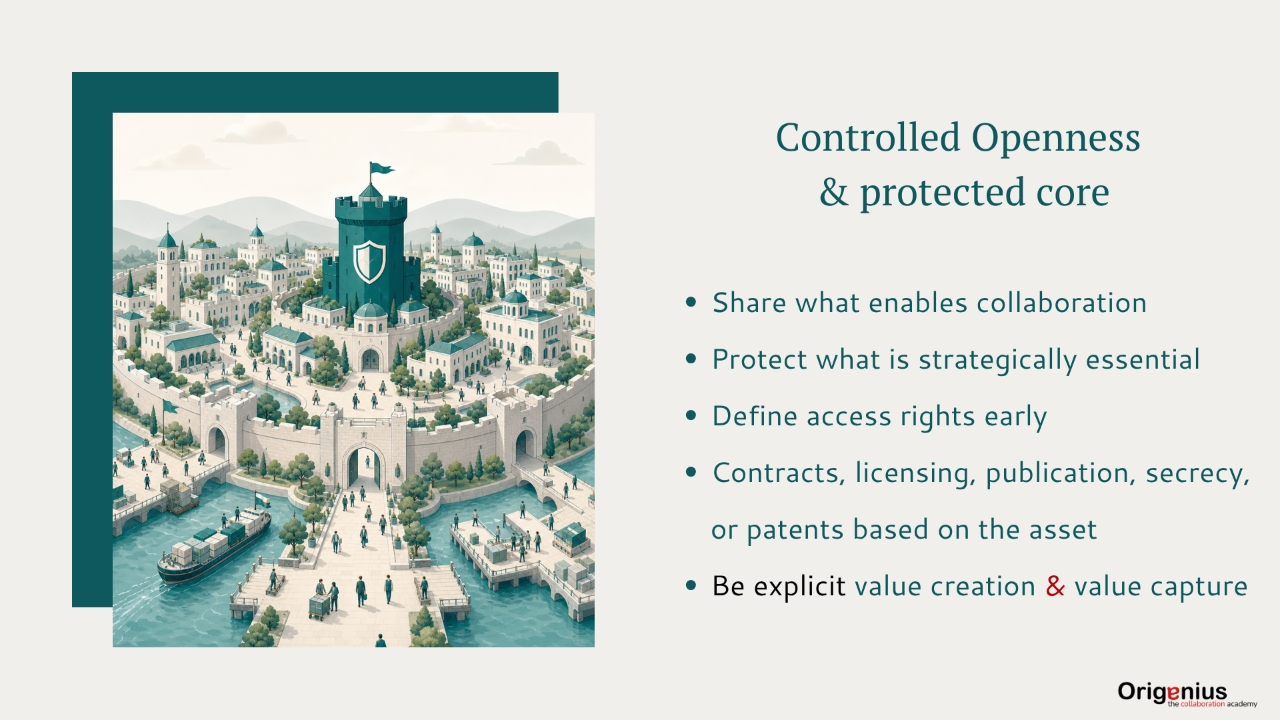
In collaborative innovation, discussions about intellectual property (IP) often start with fear.
What if we share too much?
What if a partner runs away with the idea?
What if we invest time, knowledge, and money, but cannot capture the value afterwards?
These are valid concerns.
Companies should not be naive about intellectual property, access rights, confidentiality, or ownership. Innovation takes effort. It requires investment. It creates risk. And if the collaboration works well, it may create knowledge, technology, insights, market access, or concepts that become strategically valuable.
So yes, protection matters.
But the answer is not to protect everything by default.
The answer is to protect strategically.
The goal is not to feel safe on paper. The goal is to stay able to win in the market.
Good IP thinking should not make collaboration smaller. It should make openness safer, clearer, and more productive. The real leadership question is not simply:
How do we make sure we own everything?
The better question is:
What do we need to protect, share, or access to create value and capture it afterwards?
That is a very different conversation.
It turns IP from a defensive reflex into a strategic design choice.
In the previous article, we explored why collaborative innovation does not mean sharing everything. This article takes the next step: how do you protect what matters without blocking the collaboration?
In brief
IP protection should not block collaborative innovation. The real leadership task is to protect what creates advantage, share what enables partners to contribute, and choose an IP approach that fits the market, business model, collaboration route, and value capture logic.
Leader takeaway: do not protect everything because you are afraid. Protect what your organisation needs to create value, capture value, and collaborate with confidence.
When “we must own everything” narrows the collaboration space
In many innovation partnerships, someone eventually says:
We must own all the IP.
At first sight, this sounds responsible. It sounds safe. It sounds like good business discipline.
But sometimes it is fear disguised as control.
In collaborative innovation, it can also be a warning sign.
When “we must own everything” becomes the starting point, the collaboration space becomes smaller before the real opportunity has even been explored. Potential partners become cautious. Researchers may hesitate to contribute their best ideas. SMEs may fear that the larger partner will absorb too much. Corporates may spend months in internal legal loops before the project has enough substance to evaluate.
The conversation shifts from:
What could we create together?
To:
Who gets what before we even know what “what” is?
That can turn a promising co-creation opportunity into a contractual tug-of-war.
The irony is that overstressing IP can reduce the value you are trying to protect. If the project never reaches strong collaboration, no meaningful result may be created in the first place.
A strong innovation partnership needs enough openness for partners to contribute meaningfully. If everyone hides behind walls too early, the project may stay safe, but also small.
And small, safe projects rarely create breakthrough growth.
Intellectual property is not one thing
One reason IP discussions become difficult is that people often talk about “the IP” as if it is one single object.
It rarely is.
In collaborative innovation, there are usually several layers of knowledge, rights, and results. Mixing them together creates confusion. Separating them makes the discussion much more manageable.
A few useful distinctions:
- Background knowledge: what each partner already knew, owned, or used before the project started
- Foreground results: what is developed during the collaboration
- Confidential information: what may be shared within the project but not outside it
- Publication rights: what researchers, companies, or project partners may communicate publicly
- Use rights: who may use which result after the project
- Commercialisation rights: who may bring something to market, in which field, geography, or application
- Access rights: what partners need to know or use to make their contribution possible
Once you separate these layers, the conversation becomes less emotional and more strategic.
A company may need strong protection for its background knowledge, but still allow partners to access enough information to contribute. A research group may need publication rights, but can agree on timing, review, or confidentiality boundaries. An SME may not need to own every project result, but may need the right to use a specific part in its own market.
This is where collaboration becomes more mature.
Not everything needs the same level of protection.
Not every partner needs the same access.
Not every result needs the same ownership model.
The goal is not to simplify the collaboration by pretending everything is the same. The goal is to design the right rules for the right assets.
Value capture should guide protection
A common mistake is to ask the IP question too narrowly.
Can we protect this idea?
That can be a useful question, but it should not be the first one.
The stronger question is:
What type of protection do we need to capture value from this innovation?
That question connects IP to strategy.
Because IP does not create value by itself. It creates value when it supports a route to market, investment, adoption, licensing, scaling, differentiation, or strategic positioning.
Protection should depend on the value logic of the innovation. What are you trying to achieve? Who needs to benefit? Where will growth come from? Which part of the collaboration creates strategic advantage? Which part only needs to be shared so the project can move forward?
Before deciding how to protect an innovation, it helps to clarify the value logic itself. This connects naturally to defining value before defining solutions.
If the value comes from exclusive market access, strong protection may be essential. If the value comes from speed, adoption, service, implementation, or ecosystem position, a different logic may be needed.
That is why the best IP strategy is rarely “protect everything”.
It is usually more selective:
- Protect what creates strategic advantage
- Share what enables partners to contribute
- Clarify what each partner may use afterwards
- Secure the rights needed for your route to value
- Avoid blocking the collaboration before value is created
This is not softness. It is business discipline.
Biotech and software show different IP logics
The right IP strategy depends strongly on the market and business model.
Take biotech as an example.
In many biotech contexts, strong patent protection can be essential. Development cycles are long. Regulatory costs are high. Investment needs can be substantial. Investors often want to see protected ownership before they commit serious resources.
In that context, securing exclusive IP may not be a legal luxury. It can be a condition for bringing the innovation to market at all.
Software can follow a very different logic.
Of course, some software companies rely heavily on proprietary technology. There are cases where algorithms, architectures, datasets, or technical methods need careful protection.
But in many software markets, value may come from other sources: speed, adoption, integration, user experience, data position, service quality, ecosystem access, or community. Open-source models also show that valuable businesses can be built while sharing parts of the technology and capturing value through implementation, platforms, support, services, or complementary assets.
The difference is not that biotech needs IP and software does not.
The difference is that the route to value is different.
In biotech, protection may be needed to secure investment before a long development journey. In software, the market may move so quickly that execution speed, user traction, and integration capacity become more important than formal ownership of every technical component.
That is why copying the IP reflex from one sector into another can be dangerous.
The question is not:
What is the strongest possible protection?
The better question is:
What protection fits this market, this business model, and this collaboration route?
In fast-moving markets, IP timing matters
There is also a timing issue.
In fast-moving markets, the thing you try to protect today may not be the thing that creates advantage tomorrow.
By the time formal protection is granted, the market may have moved. The architecture may have changed. The platform may have evolved. The competitive advantage may have shifted from the original idea to implementation speed, customer access, data, integration, or operational learning.
Sometimes the real asset is not the first idea.
It is the speed of learning around it.
That does not mean protection is irrelevant. It means leaders need to understand what they are really protecting.
Are you protecting the concept?
The technology?
The data?
The brand?
The method?
The customer access?
The implementation knowledge?
The market position?
The ecosystem role?
Different assets require different protection strategies.
If you protect the wrong thing, you may feel safe while the real value moves elsewhere.
Researchers, SMEs, and corporates often need different wins
IP discussions become even more complex because different partners often need different outcomes from the same collaboration.
A post-doc researcher may need scientific output, publication opportunities, and credible industry relevance. An SME may need a usable result, faster validation, market access, or a first customer case. A corporate innovation manager may need strategic fit, internal approval, future scaling potential, and protection against uncontrolled exposure.
These expectations are not automatically in conflict.
But they do need to be explicit.
A research partner may not need commercial rights, but may need the possibility to publish after review. An SME may not need ownership of all results, but may need freedom to operate in a specific application domain. A corporate partner may not need to block dissemination entirely, but may need time to check confidentiality, strategic relevance, or internal approval.
This is where win-win thinking becomes practical.
The goal is not that every partner gets the same rights. The goal is that the outcome is fair, explicit, and useful for each partner’s role.
Every partner needs the rights, access, and confidence needed to make the collaboration worthwhile.
Equal ownership is not always fair. Identical rights are not always useful. What matters is alignment between contribution, risk, value creation, and value capture.
From defensive IP to designed openness
Defensive IP thinking starts from fear.
Designed openness starts from strategy.
The difference is easy to recognise.
Defensive IP thinking asks:
How do we prevent others from using anything?
Designed openness asks:
What should each partner be allowed to use so the collaboration can create value, while protecting what truly matters?
That second question creates more room for strong collaboration.
It also helps people feel safe enough to contribute openly, because they know where the boundaries are.
It helps partners understand what can be discussed openly, what remains confidential, what can be used after the project, and what requires permission. It also reduces the risk of disappointment later.
Because many collaboration conflicts do not start with bad intentions. They start with different assumptions.
One partner assumes that a result can be used commercially. Another assumes it will be published. A third assumes access is limited to the consortium. A fourth assumes the output should be disseminated widely because public funding is involved.
Everyone may believe they agree, while they are actually working with different mental contracts.
That is where trust starts to crack.
Good IP thinking prevents this. Not by creating fear, but by creating clarity.
Strategic IP is not about building higher walls around every idea. It is about deciding which assets need walls, which gates need rules, and which exchanges create value.
IP choices are innovation governance choices
IP is often treated as something separate from collaboration governance.
That is a mistake.
In innovation partnerships, IP choices are governance choices. They define how partners can work, what they can share, what they can use, and how they can benefit afterwards.
This is why IP should not be pushed to the very end of the process. By then, expectations may already be fixed. Partners may already have invested. Assumptions may already have become emotional.
You do not need to solve every detail on day one. But you do need to identify the strategic principles early.
Who brings what?
Who needs access to what?
What can be shared during the project?
What remains confidential?
What results may be used afterwards?
What can be published?
What must be reviewed before communication?
What happens if the project changes direction?
These questions are not there to slow down collaboration. They are there to keep collaboration safe enough to move forward.
For a broader view on how this connects to partnership design, this topic links naturally to governance in innovation collaborations.
Eight leadership questions before the IP discussion becomes legal
Before the legal drafting starts, leadership should clarify the strategic position.
Start with these questions:
- 1. Which knowledge existed before the collaboration?
- 2. Which results do we expect to create together?
- 3. What do we need to use after the project to capture value?
- 4. What does each partner need to make the collaboration worthwhile?
- 5. What must remain confidential?
- 6. What can be published, shared, or disseminated?
- 7. Which rights are essential, and which are only nice to own?
- 8. Which protection model fits our business model, market speed, and growth ambition?
These questions will not replace legal expertise. They make legal expertise more useful.
Because when the business logic is unclear, legal discussions tend to become defensive. When the strategy is clear, legal work can support the collaboration instead of narrowing it.
Protect what matters, not everything
Collaborative innovation always involves some level of openness. Otherwise, partners cannot contribute in a meaningful way.
But openness does not mean exposure.
And protection does not mean paralysis.
The leadership challenge is to design the balance.
Protect what creates advantage. Share what enables collaboration. Clarify what each partner needs to use afterwards. Choose the protection model that fits the business model, market speed, and route to value.
That is how IP becomes part of the innovation strategy instead of a brake on collaboration.
Done well, strategic IP thinking helps partners contribute with confidence, reduces friction, protects the route to value, and increases the chances that the collaboration leads to stronger results and sustainable growth.
In the next article, we will go one step further and look at how governance helps innovation partnerships survive once openness, ownership, and value capture become real operational questions.
If you recognise this tension between IP protection, partner confidence, and value capture in your own innovation projects, you can reach out via the contact page. I am happy to explore what a more strategic approach to openness and protection could look like in your context.
Hey!

