
Serendipity in Innovation Is Not a Random Walk
Jul 10, 2026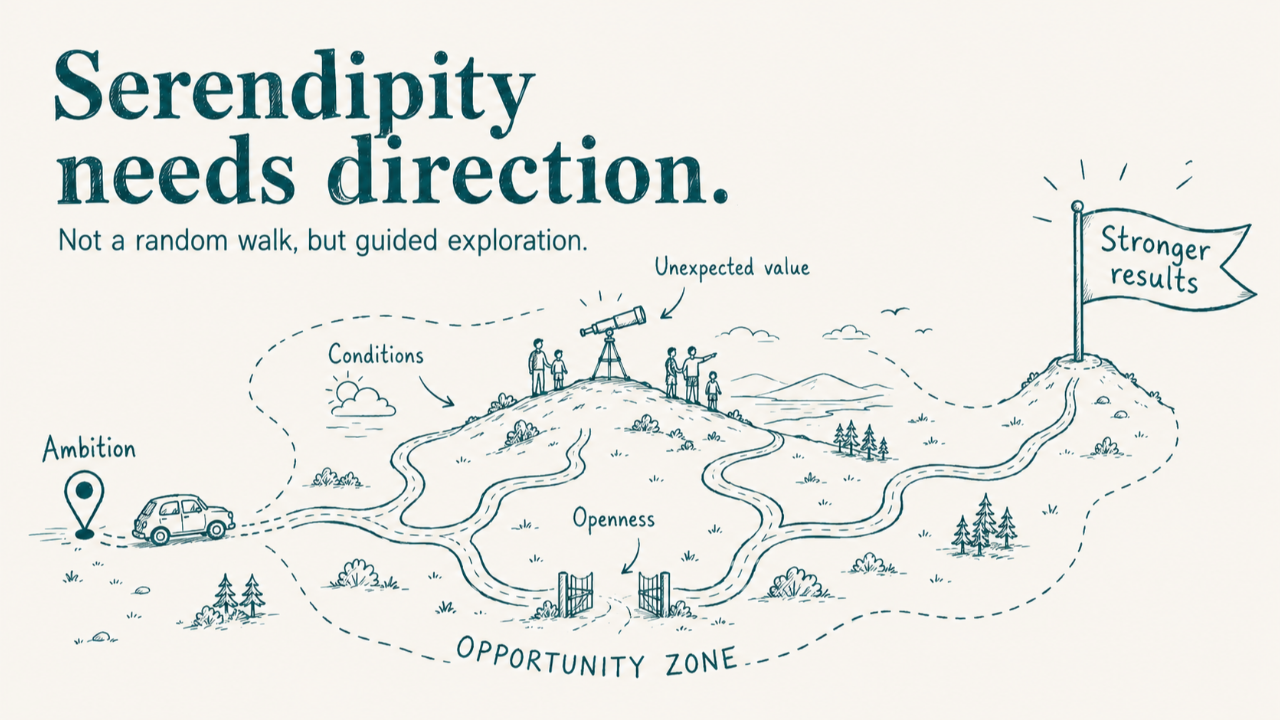
Serendipity in innovation is often misunderstood. It is not the vague hope that something good will happen if you keep wandering around. It is also not the romantic idea that breakthroughs simply appear out of nowhere.
A few months ago, I shared how our family’s 1999 eclipse adventure taught me the value of setting flexible goals instead of chasing overly fixed ones. But there is another lesson from that same day that stayed with me just as strongly.
It is about serendipity.
Not random luck. Not passive waiting. Not chaos disguised as creativity.
Real serendipity in innovation happens when you prepare well, define the right conditions, and stay open enough to recognise unexpected value when it appears. Put simply: serendipity becomes more valuable when it is not left entirely to chance.
Leaving serendipity entirely to luck is not an innovation strategy.
The original Win-Winnovation Lens story captures this beautifully through the 1999 eclipse, the decision to avoid the crowd, and the unexpected telescope moment that made the experience even stronger.
Serendipity is not the absence of structure. It is what becomes possible when structure leaves room for discovery.
The eclipse zone, not the eclipse city
On 11 August 1999, Belgium paused for something extraordinary: a total solar eclipse. Excitement was everywhere. News programmes explained where to go. Maps were shown. And Virton quickly became the Belgian city everyone talked about.
For many people, the eclipse became a race to one fixed destination.
But we approached it differently.
Instead of aiming for one city, we looked at the eclipse as a pathway. With a paper map on the table, I drew three lines: the central line where the eclipse would last longest, and the outer boundaries where totality would still be visible.
The goal was not to reach one specific town.
The goal was to find a good spot inside the right zone.
That difference mattered.
While many people headed for the same roads and got stuck in long traffic jams, we took smaller country roads. We avoided the crowd, stayed within the eclipse zone, and eventually found a small hilltop parking lot in northern France.
The conditions were right. The sky was open. The view was clear. We had our picnic.
And then serendipity arrived.
The telescope we did not bring
As we were waiting for the eclipse, a VW van pulled up beside us. Another family stepped out.
They had brought something we had not even considered: a massive telescope.
They projected the sun safely onto a screen, allowing our children to see the gradual bite of the shadow and even observe sunspots, something we could never have offered them on our own.
The experience became richer because another family was willing to share what they had brought.
The eclipse itself was already impressive, with daylight turning into twilight and silence falling over the fields. But the telescope transformed the experience.
It became the detail that lifted the day from memorable to unforgettable.
And here is the key point: we did not plan the telescope.
The telescope was not in the project plan. Luckily, reality had not read the project plan.
But we had created the conditions that made the telescope moment possible.
Had we chosen the rigid route, fighting traffic to reach one famous city, we might never have met that family. Had we stayed locked into the idea of the perfect destination, we might have missed the better experience.
The real highlight came from what was not on the plan.
You cannot schedule the telescope moment, but you can create the conditions in which it can happen.
Why innovation leaders should care about serendipity
Innovation teams often talk about serendipity as if it is random luck. A chance meeting. An unexpected idea. A surprising partner. A sudden opportunity.
Of course, chance plays a role.
But in successful innovation, serendipity is rarely just accidental. It is usually the result of a system that combines direction with openness.
That is where many organisations struggle.
Some innovation strategies are too vague. They lack direction, so teams wander around without knowing what they are looking for. That does not create productive serendipity. It creates confusion.
Other innovation strategies are too rigid. They define the destination, the route, the timing, the expected outcome, the preferred partner, the technology, and sometimes even the answer before the exploration has started. That does not create focus. It creates tunnel vision.
The sweet spot sits somewhere else.
You need enough direction to know where value could emerge. You need enough boundaries to avoid drifting everywhere. And you need enough openness to let partners, users, researchers, customers, or even complete outsiders bring something unexpected to the table.
That is why serendipity in innovation is not a random walk.
It is guided exploration.
Define conditions, not coordinates
One of the strongest lessons from the eclipse story is this: the goal was fuzzy, but not unclear.
We were not randomly driving around northern France hoping to bump into an eclipse. We had a zone. We had boundaries. We knew what mattered: being inside the eclipse path, preferably near the central line, with a clear sky and a place where we could safely stop.
That is a powerful metaphor for innovation management.
In early innovation work, especially in collaborative projects, it is often better to define conditions than coordinates.
Coordinates sound like this:
“We need this exact solution, with this exact partner, for this exact application, delivered in this exact way.”
Conditions sound like this:
“We need a solution that creates this type of value, for this type of user, within these strategic boundaries, while leaving space for partners to bring better routes or unexpected contributions.”
The first approach may feel more professional because it is specific.
The second approach is often more innovative because it creates room for discovery.
This does not mean abandoning structure. Quite the opposite. Good conditions require thought. You need to clarify what matters, what does not matter, and what is outside the innovation space.
That connects directly to strategy gives innovation direction. Strategy should not turn innovation into a rigid checklist. It should provide the direction that helps teams recognise which surprises are useful and which ones are distractions.
Define the zone clearly enough to guide people, but not so tightly that discovery has nowhere to land.
How to create serendipity in innovation without losing focus
Creating serendipity in innovation does not mean opening every door, chasing every idea, or inviting every possible partner to the table. That would not create discovery. It would create noise.
The real challenge is to design the conditions for useful surprise.
A partner may bring a use case the project team had not considered. A user may reveal a hidden adoption barrier. A researcher may spot a technical route that is less obvious but more robust. A supplier may know a faster way to test a concept. A student may ask the simple question everyone else stopped asking years ago.
These moments can be powerful, but only if the team is ready to notice them.
That readiness starts with three simple disciplines.
- First, clarify the value you are looking for. Not the final solution, but the type of value that would matter. Better adoption. Faster implementation. Lower risk. Stronger user relevance. More scalable impact.
- Second, keep the innovation space open enough. If all decisions are already fixed, partners and users can only confirm or reject what you already believe. They cannot improve it.
- Third, create moments where unexpected input can be heard before the project becomes too rigid. This can be during early partner conversations, user interviews, proposal development, pilot design, or strategic review sessions.
This is where innovation management becomes practical. It is not about adding bureaucracy. It is about building enough rhythm, structure, and reflection to prevent good surprises from disappearing between meetings.
The payoff is practical: teams spot better opportunities earlier, waste less energy on rigid plans, and turn unexpected input into stronger results.
The role of partners in structured serendipity
The telescope moment also says something important about collaboration.
In many innovation projects, organisations invite partners because they already know what they want from them. One partner brings technology. Another brings market access. A university brings research capacity. A user group provides validation.
That can be useful, but it can also reduce partners to predefined contributors.
The richer opportunity appears when partners are allowed to bring something you did not know you needed.
That is where collaboration becomes more than task distribution. It becomes a shared exploration space.
In a strong innovation partnership, each partner brings expertise, but also perspective. They see blind spots you do not see. They ask questions you did not expect. They bring tools, networks, examples, constraints, and ideas that were not on your original map.
That is why alignment by design matters. Alignment does not mean forcing every partner into the same plan. It means creating enough shared direction so unexpected contributions can be recognised, discussed, and integrated.
The telescope only mattered because it fitted the situation.
In innovation, the same applies. Not every surprise is useful. Not every new idea deserves attention. But when the conditions are clear, teams can distinguish a distraction from a breakthrough.
This also links to the risk of hidden assumptions. Teams often believe their plan is clear because everyone uses the same words. But partners may interpret those words differently. A “pilot”, a “prototype”, or a “validated solution” can mean very different things depending on the organisation, sector, or discipline.
When those assumptions remain hidden, serendipity has little room to work. When they are made explicit, unexpected contributions become easier to recognise.
When structure becomes too narrow
Many organisations unintentionally block serendipity.
They do it through overly specific calls for ideas. Through innovation roadmaps that leave no room for learning. Through project plans that reward delivery over discovery. Through KPIs that make teams nervous whenever something unexpected appears.
The result is predictable.
Teams become good at following the planned route, even when a better route appears. Partners stop bringing unexpected suggestions because there is no place for them. Users reveal new needs, but the project is already too fixed to respond. Researchers discover a more promising path, but the work package says otherwise.
In such environments, serendipity is treated as noise.
That is a missed opportunity.
Because many innovation breakthroughs start exactly there, in the moment when reality offers something better than the plan.
The challenge is not to control every step. The challenge is to recognise which unexpected step deserves attention.
Practical questions for innovation teams
If you want to create more room for productive serendipity, a few questions can help.
- Are your innovation ambitions defined as a single point or as a meaningful zone?
- What are the minimum conditions for success?
- How do you welcome the unexpected?
- Who might bring the telescope?
If the target is too narrow, you may create unnecessary traffic jams. Everyone is pushed towards the same fixed answer. That can feel efficient, but it often reduces the chance of discovering better options.
This is where teams should be explicit. What value must be created? For whom? Which boundaries matter? Which constraints are real? Which assumptions still need testing?
Welcoming the unexpected is not a soft question. It is a design question. Do your meetings, governance moments, partner conversations, and decision processes allow people to bring surprises? Or do they only reward progress against the original plan?
And finally: who might bring the telescope?
In other words, which partners, users, researchers, suppliers, students, or external voices could enrich the project in ways you cannot predict yet?
That question is especially relevant for SME innovation managers and corporate innovation managers. SMEs often have limited resources, so they cannot afford long random explorations. For SMEs, structured serendipity is not a luxury. It helps avoid wasting scarce time and budget on routes that looked logical too early.
Corporates often have more resources, but their internal systems can become so structured that unexpected opportunities struggle to survive. For corporates, the danger is often not lack of ideas, but systems that quietly filter out surprises before they can become valuable.
In both cases, the answer is not chaos. The answer is better conditions.
Postdoctoral researchers and research teams face the same challenge from another angle. Proposal writing often pushes projects towards predefined impact stories. Yet real impact may emerge when industry partners bring unexpected context, constraints, or use cases.
Funders need clarity, but strong proposals should still leave room for learning once industry context becomes visible. The trick is to make the research direction clear enough for funders, while keeping the collaboration open enough to learn from reality.
From lucky coincidence to innovation capability
The telescope moment was lucky.
But the possibility of that luck was designed.
We chose the zone over the city. We avoided the crowd. We stayed open to the country roads. We did not know who we would meet, but we created a situation in which meeting someone interesting was more likely.
That is exactly how organisations can approach serendipity in innovation.
Not by waiting for magic. Not by pretending everything can be planned. But by building an innovation system that combines direction, openness, collaboration, and reflection.
When that works, innovation becomes more resilient. Projects adapt faster. Partners stay more engaged. Unexpected insights are not lost. Ideas become stronger because they are shaped by reality, not protected from it.
And that is where success and growth start to appear.
Not because every step was controlled.
But because the organisation was ready to recognise value when it appeared.
Breakthroughs often come from what was not on the original plan, but only if the system is ready to notice them.
The leadership lesson
For innovation leaders, the lesson is simple but demanding.
Do not confuse openness with lack of discipline.
And do not confuse discipline with rigid control.
The real leadership challenge is to design conditions in which people can explore with purpose. Clear enough to move. Open enough to adapt. Structured enough to learn. Flexible enough to welcome the telescope moment when it appears.
That is where serendipity becomes a leadership capability rather than a lucky accident.
If this resonates with your own innovation challenges and you want to translate it into a practical approach, you can contact me through the contact page.
Hey!

