
When transparency turns into noise: a parking sign in Trouville-sur-Mer
Jul 28, 2026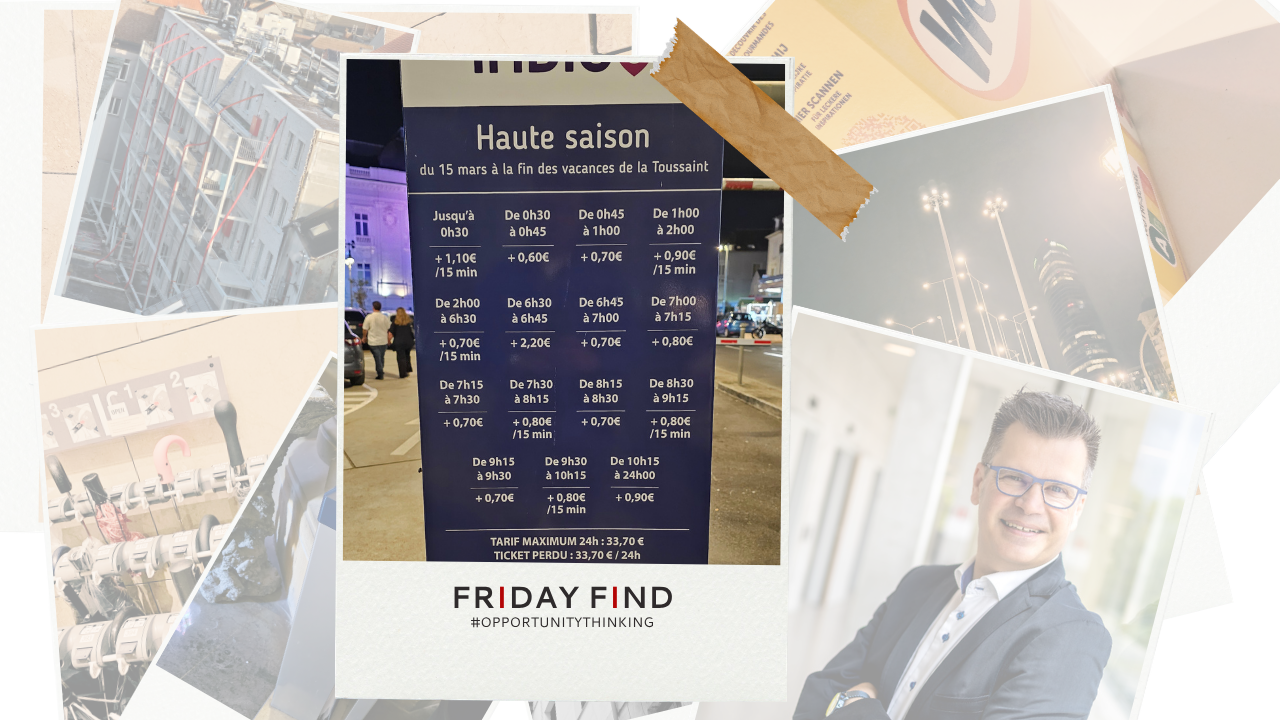
Last summer in Trouville-sur-Mer (France), I walked up to a car park sign that looked like a masterclass in transparency. It promised full clarity on tariffs.
It delivered full detail instead.
Twelve different tariffs, split by time windows, exceptions, and conditions. I stood there longer than I want to admit, trying to decode it. In the end, I only understood one thing: 34 EUR for a full day. And that told me enough to decide it felt expensive.
The sign disclosed everything, and explained almost nothing.
The funny part is this: the sign did exactly what it was designed to do, disclose everything. But the moment the explanation became too elaborate, it stopped helping.
That little parking sign is a surprisingly accurate mirror of what I often see in pitches.
The pitch moment where smart people get lost
In a pitch, the goal is not to prove you know everything. The goal is to help someone quickly understand:
- what you are solving
- why it matters
- what you are proposing
- what you want from them
Yet under pressure, many strong profiles flip into a different mode. They start “being helpful” by adding more context, more nuance, more detail, more disclaimers. Especially in engineering and research teams, where accuracy is a professional reflex.
Under pressure, smart people do not get vague, they get detailed.
And to be clear: this is not a lack of intelligence. It is often an early sign of stress behaviour.
Also, if you recognise yourself here: you are not “too much”. You care. The trick is to care for your listener’s brainspace as much as you care for accuracy.
When stress increases, clarity does not automatically increase with it. Sometimes stress creates the opposite, a kind of information overflow that makes your audience work too hard to follow you.
If your explanation needs a user manual, your pitch has already become a negotiation with attention.
Why stress pushes you into over explaining
Stress does something sneaky. It shifts your focus from “make this easy to understand” to “make this impossible to criticise”.
So you start defending the idea before anyone attacked it.
You add edge cases. You cover every scenario. You show you have thought about everything. In your head, you are building trust.
In your audience’s head, they are losing the thread.
When stress rises, you start pitching to avoid criticism, not to create understanding.
Just like the Trouville sign: it did not build confidence, it created friction.
Less is more, but only if you cut the right things
“Less is more” is not an excuse to be vague. It is a kindness to your audience. You remove detail that does not serve the decision.
Here are three practical cuts that usually improve a pitch fast:
1) Cut the tariff table, keep the bottom line
Give the core message first. Then only add detail if it is requested.
In pitch terms: start with the one sentence value, then the one paragraph explanation. Keep the appendix for questions.
2) Stop solving objections that no one raised yet
If you answer five potential objections before your audience has even agreed the problem is real, you create doubt that was not there.
3) Replace complexity with structure
Complex topics can be explained simply when the structure is strong.
A useful rule: if you cannot summarise your pitch in four steps, you do not have a complexity problem, you have a story problem.
Cut the tariff table. Keep the bottom line.
A simple reset that prevents tariff sign pitching: the NABC canvas
If you know the NABC canvas, this is exactly where it shines. Not as an extra framework to explain, but as a quick filter that forces relevance.
When you feel yourself sliding into over explaining, do this as a rewrite exercise. Four lines, no more:
- Need: what is the pain, for whom, and why it matters
- Approach: what you will do, in plain language
- Benefits: what changes, and why it beats doing nothing
- Alternatives: what people do today, and why your option is better
Before you write those four lines, take 60 seconds alone. No slides. No talking. Just write the lines on paper.
If it does not fit in four lines, you are probably still describing the tariff table instead of the bottom line.
If you want a quick, practical way to do this, you can use our free tool here: NABC canvas. The idea is simple: compress your thinking first, then expand into slides, evidence, architecture, and edge cases.
Here is a simple example, just to show the level of detail:
- Need: “Our project partners lose time and trust because decisions are made with fragmented information.”
- Approach: “We set up one shared working rhythm and one decision log across partners.”
- Benefits: “Faster alignment, fewer rework cycles, more predictable delivery and better results.”
- Alternatives: “Today it is emails and ad hoc meetings, which creates gaps and delays.”
That is enough to earn attention. The technical depth can come later, once the listener is with you.
And yes, here is the playful truth that still lands: if your pitch starts to look like a parking tariff poster, congratulations, you found the problem early.
Fast mode for busy days: say your Need and Benefits out loud in 20 seconds. If you cannot, you are not ready to pitch yet.
Compress first. Expand later.
If you want to go a level deeper on how communication styles shift under pressure (and how to handle them in multi stakeholder settings), this is closely related to what we unpack in interaction styles under pressure.
A simple reset question when you feel yourself spiralling
Next time you catch yourself going into “twelve tariffs mode”, pause and ask yourself:
What does my listener need to decide, right now?
That question brings you back from completeness to relevance.
It also helps you spot whether you are pitching for clarity, or pitching for safety.
The upside: clearer pitches lead to a faster yes
When your audience understands you quickly, three good things happen:
- discussions become sharper, because questions are about choices, not about decoding
- trust grows, because your message feels controlled and intentional
- decisions come faster, which improves your odds of real traction, results, and growth
A pitch that lands is not a performance. It is an alignment tool.
A pitch that lands is an alignment tool, not a performance.
And alignment is what turns a good idea into an approved project, a funded study, a signed partner, or a confident next step, with better results and growth to show for it.
If you are curious how this could look in your specific context, you are welcome to get in touch via the contact page for a conversation.
Hey!

