
How to kill collaboration
Oct 27, 2026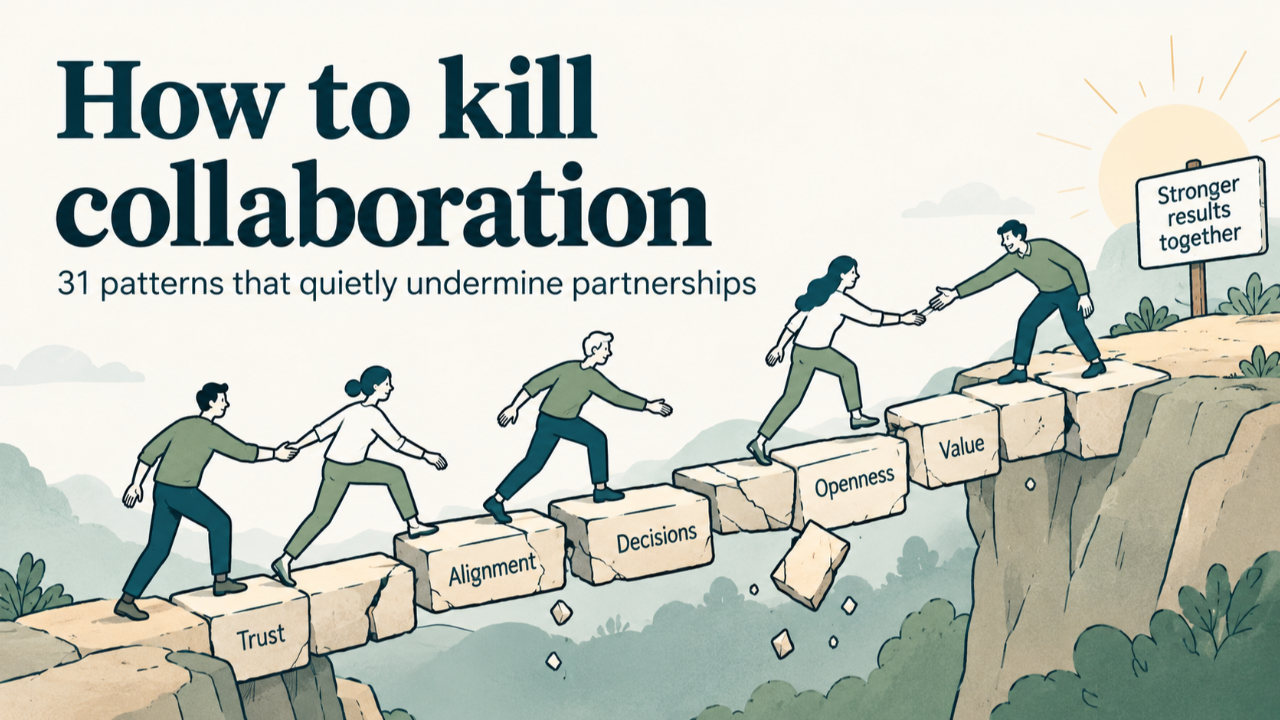
Most collaborations do not fail because somebody walks into the room determined to destroy them.
The more dangerous collaboration killers are usually less obvious. They appear as sensible questions, familiar procedures, protective reflexes, good intentions, or habits that once had a perfectly valid reason.
Over the years, through building and guiding innovation partnerships, consortia, and ecosystems, I have seen these patterns appear again and again. Some slow progress. Some reduce trust. Others quietly turn collaboration into little more than coordinated individual work.
The challenge is that many of them look perfectly reasonable when they first appear.
What kills collaboration? Usually not one dramatic mistake, but a series of small behaviours that reduce trust, slow decisions, hide assumptions, weaken alignment, or prevent partners from creating value together.
The 31 strategies below are therefore not really instructions. Although, if your ambition is to make collaboration painfully slow, a few of them are remarkably effective.
Think of them instead as a diagnostic checklist of common failure patterns in collaboration.
You may recognise some in other people. You may also recognise a few in yourself. I certainly do.
Short on time? Scan the titles first. The ones that make you slightly uncomfortable are probably worth opening.
You do not need to read all 31 in one go. Use the list as a reference and return to the patterns that show up in your own partnerships.
Recognising the pattern is already part of the solution. It helps you avoid triggering these collaboration killers through your own behaviour and respond more constructively when somebody else introduces them.
The goal is not to find the guilty party. It is to spot the pattern early enough to counter it, protect the collaboration, and create stronger results together.
31 ways to kill collaboration
Move to: 1-10 Trust & behaviour · 11-20 Rules & participation · 21-31 Decisions, alignment & value
Disagreement is normal in collaboration. In fact, if different partners bring different expertise and perspectives, disagreement can be extremely useful. A good way to kill that value is to shift the discussion from the idea to the person behind it. Once disagreement starts feeling personal, people move into familiar fight, flight, or freeze reactions. Some defend their position more aggressively. Others become cautious, withdraw, or simply stop contributing. Ideas should be challenged, tested, improved, and sometimes rejected. But when someone's credibility, motives, personality, or standing feel under attack, the conversation becomes about self protection rather than joint problem solving. Keep the challenge attached to the idea. Question the reasoning, evidence, or assumptions without turning disagreement into personal confrontation. Strong collaboration needs enough safety for people to disagree and still stay engaged in finding a better result. Collaborative innovation is often interdisciplinary by design. Engineers, researchers, social scientists, users, market experts, and operational teams may all look at the same challenge differently. That diversity is one of the reasons to collaborate in the first place. It helps reveal whether you are solving the real problem or only the most obvious version of it. The killer appears when disagreement triggers a competence check instead of curiosity. Are you really qualified to judge this? That is outside your field. At that point, people start defending their territory. Some retreat into their own discipline. Others stop contributing beyond what is formally expected of them. A more useful question is: What do you see that I might be missing? Strong collaboration does not require experts to agree. It requires enough curiosity to understand why another expert sees the issue differently. Unfamiliar expertise is something to explore, not something to disqualify. Bad news is part of innovation. Experiments fail. Dependencies slip. Assumptions turn out to be wrong. Markets change. A technical solution behaves differently in practice than expected. The earlier that information surfaces, the more options the partnership still has. So one effective way to kill collaboration is to make bad news dangerous for the person who brings it. Why did you let this happen? Who is responsible for this? How could you not have prevented it? If blame is the first reaction, people learn quickly. Risks get softened. Problems travel slowly. Failures are explained away until they can no longer be ignored. Accountability still matters. But surfacing a problem and assigning responsibility are not the same conversation. First understand what happened, what it means, and what needs to happen next. Then address learning and accountability. Early bad news gives a collaboration room to adapt and still achieve a strong result. Harmony feels good. It is therefore tempting to protect it. Let's not make this bigger than it is. We do not want unnecessary tension. We can come back to that later. Meetings remain pleasant. Nobody openly disagrees. But assumptions stay untested, concerns remain hidden, and frustrations quietly accumulate. People may leave the meeting feeling that everything went well, while still carrying concerns they did not feel able to raise. The collaboration can look healthy right until one of those delayed issues becomes expensive to solve. The answer is not conflict for the sake of conflict. It is building enough trust to have difficult conversations while there is still time to do something about them. Strong partnerships can handle disagreement without losing sight of the shared result. Do not prioritise harmony over results. Sometimes the conversation that feels uncomfortable today is exactly the one that prevents a much bigger problem tomorrow. Expertise, experience, and leadership can make collaboration stronger. They can also become very convenient shortcuts around discussion. I know this field. We have done this before. Trust me, I'm an engineer. This is simply the right approach. The problem is not expertise. The problem begins when expertise is used to make other perspectives irrelevant. That is especially risky in interdisciplinary innovation. A technical expert may underestimate adoption. A market expert may miss implementation constraints. A senior leader may overlook what the frontline already knows. Use expertise to strengthen the conversation, not close it. Explain the reasoning behind your position. Invite challenge. Stay curious about factors outside your own domain. Strong collaboration does not diminish expertise. It combines expertise so the eventual result is stronger than any one perspective could have produced alone. Leadership matters, but in cross organisational collaboration it is rarely as simple as appointing one permanent leader. Different partners bring different authority, expertise, resources, networks, and stakeholder relationships. Leadership may therefore need to shift as the collaboration progresses. A good way to derail that is to turn leadership into a battle over status. Who is leading this? Why should they chair the meeting? Why is their organisation in front? Soon, more energy goes into visibility, control, and position than into solving the challenge. A technical partner may need to lead one phase. Another partner may be better placed when market access, stakeholder relationships, or implementation become central. Separate leadership from ownership and status. The useful question is not Who wins the leadership role? It is What kind of leadership does the collaboration need right now, and who is best placed to provide it? Every partner has its own interests, responsibilities, and success criteria. That makes it tempting to say: That is their problem. They need to make their own business case. We delivered our part. What they get out of it is up to them. That may sound like clear accountability. But collaboration is more than a collection of separate contributions. If you understand what matters to a partner but make no effort to help create the conditions for their success, you are coordinating rather than co creating value. That does not mean taking responsibility for everybody else's results. It means understanding what a meaningful win looks like for each partner and looking for ways the partnership can support those wins. Sometimes a small change in timing, access, design, or introductions can create significant value for another partner. Win-Winnovation becomes possible when partners help each other succeed and the combined result becomes stronger than what they could create independently. Assumptions are unavoidable in collaboration. We make them about roles, timing, budgets, access, decision rights, responsibilities, and what other partners are going to contribute. The dangerous ones are not always the assumptions we miss. Sometimes they are the assumptions we notice but leave unchallenged because they happen to work in our favour. A partner expects more access than has actually been agreed. Someone thinks a budget is already secured. Another participant assumes a decision has been made. Correcting the misunderstanding might complicate the conversation, so leaving it alone feels convenient. Until it becomes an expectation. Then the issue is no longer simply the misunderstanding. You knew I expected this, and you never corrected me. Surface assumptions early, especially the convenient ones. An assumption that helps you today can become the reason someone stops trusting you tomorrow. Past experience matters. Previous failures, difficult partnerships, missed deadlines, and disappointing pilots can all teach valuable lessons. The killer appears when those lessons become permanent conclusions. We tried that before. That kind of partner never works. We already know how this ends. At that point, experience stops informing judgement and starts acting as a veto. But context changes. People change. Technology changes. Markets change. Timing changes. A previous failure can reveal useful risks and warning signs without automatically proving that the same conclusion applies today. A better question is: What did we actually learn last time, and what is different now? Use experience to sharpen judgement, not to close exploration. Strong collaboration learns from the past while leaving room for new circumstances, better choices, and stronger results. Strong principles are valuable. They protect quality, safety, ethics, strategy, and organisational identity. The killer appears when principles become untouchable rules that no longer need to be questioned. We have always done it this way. Our procedures do not allow that. That is simply one of our principles. Sometimes the principle is genuinely important. But sometimes what is presented as a principle is actually a habit that once had a very good reason. The context changed years ago. The habit remained. Eventually people stopped asking why it existed and the habit acquired the status of a rule, or even a principle. This becomes especially restrictive when different organisations bring different histories and procedures into one collaboration. Ask: Why does this rule exist, and would we create it again today? Protect what genuinely needs protecting, but leave enough room to question practices and adapt to a new context. Strong collaboration should not allow yesterday's habits to unnecessarily limit tomorrow's results. Few things can end a promising discussion as efficiently as mentioning regulation without explaining it. GDPR. Compliance. Legal will never allow this. And the conversation stops. Regulation matters. GDPR, medical device regulation, cybersecurity requirements, procurement rules, and other frameworks can impose genuine constraints. But before treating a regulation as a blocker, first ask whether it actually applies. Then understand what it requires, what it restricts, and what remains possible. Especially when other partners are less familiar with the regulation, simply naming it can make a challenge appear impossible. Bring regulatory knowledge into the collaboration early enough to shape a workable approach. Treat regulation as part of the design space rather than a wall around it. A constraint can change how you solve the problem without removing the possibility of solving it. Confidentiality, intellectual property, and legitimate business interests matter. The killer appears when confidentiality becomes the automatic answer just as the conversation reaches something useful. That is confidential. We cannot share that. That touches our IP. I need to clear that with legal. Sometimes those boundaries are entirely justified. But if every meaningful detail is protected before partners explore what can safely be discussed, the collaboration stays superficial. Important assumptions remain untested and decisions are made with too little information. The answer is strategic openness. Clarify what genuinely needs protection, what can be shared, and under which conditions. Strong collaboration does not require sharing everything. It requires sharing what is needed to create value together while protecting what should remain protected. Different disciplines and organisations often use the same words differently. A researcher, engineer, clinician, policymaker, and business manager may all use words such as pilot, validation, impact, or success while meaning slightly different things. The killer appears when the team tries to eliminate every possible difference in terminology before moving forward. Definitions get discussed. Documents get created. Agreements get refined. It feels productive because everyone is busy and the work looks structured. But being busy aligning words is not the same as moving the collaboration forward. The relevant question is whether a difference in meaning could affect a decision, expectation, commitment, or result. Clarify those terms early. Let less critical differences surface while the work progresses. Strong collaboration does not require identical language. It requires enough shared understanding to make good decisions, plus the openness to ask questions when something is unclear. Language differences are real, and a limited shared glossary can be useful. The killer appears when creating that glossary becomes a project in itself. Terms are collected. Definitions are debated. Wording is refined. Exceptions are documented before the collaboration has really started. That degree of precision can be necessary in a legal contract, where rights, obligations, and liabilities may depend on exact wording. But collaboration is not a legal contract. In everyday collaboration, meaning is often created through interaction, concrete examples, decisions, and tested assumptions. Use a limited glossary where it adds real value, especially for terms that affect commitments, decisions, expectations, or results. Do not try to eliminate every possible misunderstanding upfront. Aim for enough shared understanding to move, learn, and create value together, while maintaining the openness to ask questions when new ambiguity appears. Good collaboration advice often starts with: involve the relevant stakeholders. The problem begins when that becomes: involve everyone, from the beginning, at the same time. Every additional person brings another perspective, interest, assumption, and priority into the room. Before the core challenge is clear, the discussion broadens and decisions slow down. Large meetings can even create a surprisingly safe place not to interact. Some participants mainly listen to the other participants rather than challenge assumptions, contribute expertise, or help shape the direction. The issue is not whether stakeholders matter. It is when and how they should be involved. Map stakeholders early, then involve them deliberately. Start with the people needed to frame the challenge, explore the opportunity, and create direction. Bring others in when their expertise, perspective, or mandate strengthens the next step. The goal is not maximum attendance. It is the right stakeholders, at the right moment, in a setting where they can actually contribute to stronger results. Choosing the right people matters. Representation can matter too. The killer appears when deciding who is allowed to participate becomes a project of its own. Who should attend? Who represents each organisation? Is that person senior enough? Who has been left out? Who needs to approve the list? Before long, more energy is going into designing the meeting than addressing the challenge. Use purposeful participation instead. Ask who is needed for the next meaningful step. What perspective, expertise, or mandate do they bring? What decision, learning, or progress should their participation enable? You do not always need perfect representation. You need the right people, at the right moment, for the result you are trying to achieve. Partner involvement sounds good. So invite people to comment. What do you think? Any feedback? Does everyone agree? There is just one small problem. The scope is already fixed. The solution is largely designed. The budget is allocated. The timing is set. The most important assumptions have already shaped the decision. Partners are invited to contribute after there is almost nothing meaningful left to influence. That looks like involvement, but it is not co creation. You do not need everyone in every early conversation. But involve partners at the point where their expertise can still change something that matters. Be clear about what has already been decided, what remains open, and where their input can genuinely improve the result. Strong collaboration creates space for input to make decisions better, not simply validate decisions already made. More partners can mean more expertise, reach, credibility, resources, and networks. So adding one more partner often feels obviously beneficial. They might be useful later. It would look stronger if they joined. We should involve them too. Yet every additional partner also adds interests, expectations, interfaces, dependencies, and coordination. A partnership can therefore become larger without becoming stronger. Do not aim for a small partnership simply for the sake of being small. Instead, be clear about why each partner is there and what unique value they contribute. A useful question is: If this partner were not involved, what capability, perspective, access, or value would genuinely be missing? The goal is a lean and mean partnership: no unnecessary complexity, but all the capabilities needed to create the intended value. Collaboration depends on interaction. Questions need answers. Assumptions need checking. Small decisions often keep the work moving. The killer appears when you become just unavailable enough to create friction. Reply late. Make meetings difficult to schedule. Have people call you back at a later date. Leave questions unanswered long enough that partners no longer know whether to wait, proceed, or escalate. The result is uncertainty. Partners start building workarounds, making assumptions, or postponing decisions. Momentum drops and frustration starts replacing trust. The answer is not constant availability. It is predictable accessibility. Partners should know how to reach you, when they can reasonably expect an answer, and who can step in when you are unavailable. Being busy is normal. Becoming a bottleneck is a choice. Clear mandates matter. People should know what they can decide, what requires approval, and where responsibility sits. But when a decision becomes uncomfortable, questioning the mandate can become a very convenient alternative to making it. Do you actually have the authority to decide this? Who gave you that mandate? Should this not go back to management? Sometimes those are entirely valid questions. But when they appear repeatedly, the collaboration starts discussing who may decide instead of deciding. That creates delay, weakens ownership, and pushes decisions away from the people closest to the work. Clarify decision rights early. Define who decides what, what genuinely requires escalation, and which choices can remain close to the people who understand the issue. A good mandate creates confidence to act. It should not become a reason to avoid acting. Governance matters. Clear escalation paths and decision structures can prevent confusion. They can also give decisions many places to hide. A question moves from the working team to the steering committee. The steering committee sends it to management. Management wants legal input. Legal refers it back to a board or another committee. Every step can look reasonable on its own. Together, they create a system where nobody quite says yes or no. Responsibility becomes diluted, partners wait, and momentum disappears. Keep decision rights as close as possible to the people who understand the issue and are accountable for the outcome. Escalate when another level genuinely adds value, not simply because that level exists. A decision process should help decisions happen, not give them more places to hide. Consensus can create commitment. It can expose concerns, reduce resistance, and help partners move together. The killer appears when complete agreement becomes a prerequisite for every next step. We need everyone on board. Let's not move until everybody is comfortable. We should discuss this once more. In multi stakeholder collaboration, partners naturally have different interests, priorities, and risk profiles. Full agreement on every detail is rarely realistic, especially while uncertainty is still high. Distinguish between decisions that genuinely require consensus and decisions that only require sufficient alignment. Sometimes the next step is a reversible experiment, a pilot, or a small commitment designed to generate more information. Strong collaboration does not wait for certainty or universal enthusiasm. It builds enough alignment, trust, and clarity to take the next sensible step. Analysis matters. You should understand evidence, assumptions, risks, uncertainties, and alternatives. But analysis can also become a very sophisticated way of avoiding action. We need more data. Let's validate it once more. We should understand the market better first. At some point, additional analysis stops reducing meaningful uncertainty. Innovation rarely offers complete certainty upfront. Some questions can only be answered by taking the next step, testing something, or engaging with the real market. Meanwhile, the window of opportunity keeps moving. Competitors act. Customer needs shift. Partners lose interest. Funding changes. Technologies evolve. Timing passes. Instead of asking Are we certain enough?, ask: Do we know enough to take the next sensible step? Reduce uncertainty enough to move, learn, and create value while the opportunity is still open. Ambitious innovation can require serious investment. At some point, partners may need to commit money, people, infrastructure, and time. The killer appears when the budget discussion becomes the starting point, before the partners have sufficiently explored the opportunity. What budget can you put on the table? How much are you prepared to invest? Can you commit resources for the full project? Asked too early, these questions make an emerging collaboration feel risky before the partners understand the problem, potential value, or key uncertainties. Match the size of the commitment to the level of understanding. Start with the smallest meaningful investment that allows partners to learn, test, validate, and reduce uncertainty. Let the commitment grow as confidence in the opportunity grows. A major investment can make perfect sense later. It becomes much easier to justify once there is a shared understanding of the opportunity and a credible path towards results. A focused challenge enters the room. Then somebody adds another stakeholder need. Another exception appears. Another department needs to be covered. Someone introduces a future scenario that might matter. Each addition can sound perfectly sensible. Together, they expand the search space until priorities blur, complexity increases, and momentum disappears. The problem is not ambition. The problem is expanding scope without prioritisation. Strong collaborations look for the smallest meaningful part of the challenge they can address together, learn from, and build upon. Monitor scope expansion deliberately. Every extra requirement, stakeholder group, or use case should earn its place, even if adding it could increase the potential impact. More impact is valuable only if the collaboration remains focused enough to act, learn, deliver, and create value. Alignment matters. But alignment does not mean that every partner must want exactly the same thing. Different goals are not automatically misalignment. Partners often collaborate precisely because their interests and capabilities are complementary. One organisation may want new knowledge. Another wants market access. A research partner may seek validation. A public organisation may want better service outcomes. A technology partner may see a business opportunity. Those goals can be different and still reinforce each other. In fact, if every partner wants exactly the same outcome, from the same market, for the same reason, you may find yourself selecting competitors rather than complementary partners. Make individual goals explicit. This is part of designing effective alignment in collaboration. Then ask whether there is enough alignment for the partners to help each other move towards those goals while creating a meaningful result together. Strong collaboration does not require identical destinations for identical reasons. It requires enough alignment and complementarity to create more value together than apart. Contribution matters. Every partner should bring something useful. But dividing the work is not automatically collaboration. You take this part. We deliver our piece. They are responsible for that work package. The tasks may be clear. Tracking may be easy. Everybody may deliver exactly what was promised. Yet the direction, assumptions, and important choices may already have been defined somewhere else. The partners are contributing pieces to somebody else's plan rather than shaping the result together. Collaboration goes further. It creates room for relevant partners to influence the challenge, test assumptions, explore alternatives, and help shape the direction. That does not mean every decision needs to be collective. It means the expertise of the partners can genuinely change what the work becomes. Strong contributors deliver good pieces. Strong collaboration combines those contributions into something better than any partner could have created alone. Classic project management often asks whether tasks were completed, milestones reached, and deliverables submitted. Those are useful questions. They just do not tell you whether those tasks are still the right ones. Innovation happens in a changing context. Markets move. Technology evolves. Regulation changes. Customer expectations shift. New learning changes what you know. A work plan designed a year ago can therefore be executed perfectly while its relevance quietly disappears. Work package complete. Milestone achieved. Everything is green. And yet the collaboration may be delivering less and less value. Project management asks: did we do what we planned? Innovation management also needs to ask: is what we planned still worth doing? Measure more than activity. Regularly ask whether the contributions still make sense today, what has been learned, and whether the combined result will still create value in the context of tomorrow. Success is not simply ticking the boxes. It is creating a result that still matters. Innovation changes. New information appears. Priorities shift. Assumptions fail. What looked like the right target six months ago may genuinely need to change. That is not the problem. The killer appears when expectations change quietly. A milestone that was sufficient suddenly is not. A partner is expected to contribute more. Decision criteria change after the work has been done. The target moves without acknowledging that it moved. Partners end up working according to yesterday's expectations while being judged against today's. Do not freeze goals simply to avoid change. Instead, make change visible. Explain what changed, why it changed, what the consequences are, and what the partners need to adjust together. Strong collaboration can handle changing goals. Trust suffers when people pretend the goal never moved. A shared objective matters. But collaboration becomes fragile when the conversation stops there. Different partners can support the same project for very different reasons. One may want market access. Another wants technological validation. A researcher may want scientific impact. A company may want a new business opportunity. Another partner may value access to a network or customer relationship. If those interests remain unexplored, the partnership can look aligned while expectations quietly diverge. Ask a simple question: What would make this collaboration a win for you? Then listen. Understanding what another partner needs does not mean promising to deliver everything they want. It means understanding the value they are looking for and exploring how the partnership can support those interests alongside the shared objective. Strong collaboration understands both what the partners want to achieve together and why achieving it matters to each of them. That is at the heart of Win-Winnovation: creating conditions in which individual partner wins reinforce the shared result.1. Make it personal
2. Question the expert
4. Blame the person
5. Avoid difficult conversations
6. Be reasonable, do it my way
7. Fight over who gets to lead
8. Make their success their problem
9. Let convenient assumptions stand
10. Use the past to block the future
11. Turn principles into untouchable rules
12. Mention GDPR and stop
13. Hide behind confidentiality
14. Agree on every term before you start
15. Build the perfect dictionary
16. Bring all stakeholders in at once
17. Create a committee to decide who sits on the committee
18. Ask for input after deciding
19. The more, the merrier
20. Make yourself difficult to reach
21. Ask for a mandate instead of a decision
22. Add another decision level
23. Wait for complete consensus before moving
24. Keep analysing until the opportunity disappears
25. Start with the budget, not the opportunity
26. Keep expanding the problem
27. Treat different goals as misalignment
28. Divide the work and call it collaboration
29. Measure tasks, not value
30. Move the goalposts without saying so
31. Never ask what your partners need to win
Collaboration killers are usually symptoms
The interesting thing about these 31 collaboration killers is that most of them are not caused by bad people or by organisations deliberately trying to undermine the collaboration.
The killer behaviour is often the visible symptom. The real collaboration problem sits underneath it.
- Uncertainty
- Lack of trust
- Unclear roles
- Fear of losing control
- Different expectations
- Organisational habits
- Pressure to protect individual interests
That is why simply telling people to collaborate better rarely changes much.
Strong collaboration requires deliberate choices about how partners communicate, make decisions, share information, challenge assumptions, adapt, and create value together.
Recognising these patterns helps in two directions.
You can notice when your own behaviour starts creating unnecessary friction or closing the conversation.
And you can recognise the same patterns when another partner introduces them, giving you a chance to respond constructively before the collaboration drifts too far. That ability to spot and correct these signals early is part of detecting and correcting drift in innovation partnerships.
The goal is not perfect harmony.
It is a partnership where differences can become productive, difficult issues surface early, and each partner has a reason to help the others succeed.
That is where collaboration becomes Win-Winnovation: not simply dividing the work, but creating stronger results together than the partners could achieve alone, with a better foundation for lasting impact and growth.
If you recognise some of these patterns in your own partnerships and want to explore how to address them, you are welcome to get in touch via the contact page. I am happy to think along with you.
Hey!

