
Collaborative Innovation: How to Work With Partners Without Sharing Everything
Aug 25, 2026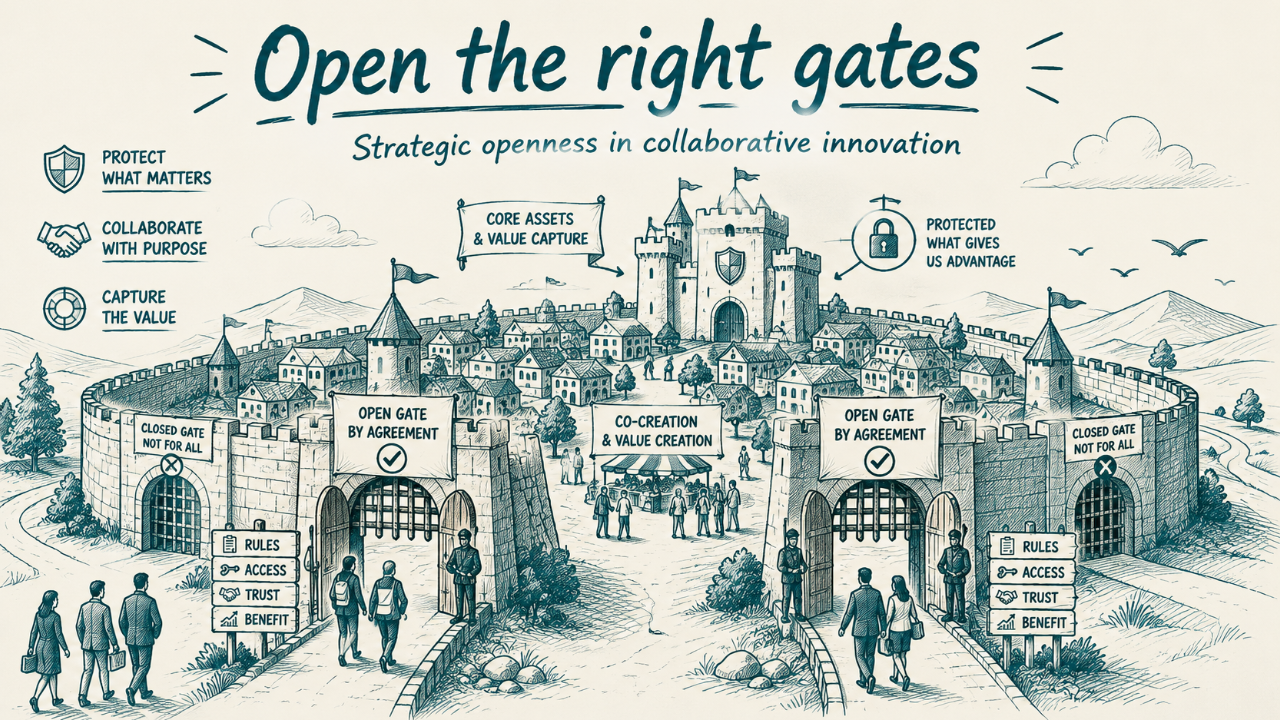
When companies consider innovation with external partners, the same concern often appears quite quickly:
What do we need to share, and what do we need to protect?
It is a very valid question. Companies invest time, money, expertise, and risk into innovation. Research groups build knowledge over many years. SMEs may depend on one critical technology, customer insight, or market position. Corporates often need to protect strategic assets across several business lines.
So yes, protection matters.
But for company leaders, this is not a legal detail. It is a strategic choice. The way you design openness determines whether collaboration gives you access to new knowledge, faster validation, and growth, or whether it creates confusion, hesitation, and value leakage.
Before asking what must be protected, ask what the business needs to win from the collaboration.
Many organisations still think in two extremes. Either innovation stays closed and everything remains inside the company, or collaboration means opening up too much and losing control.
That is a false choice.
A useful way to picture this is as a medieval city. Some organisations keep all gates closed and protect everything inside the walls. Others open every gate and hope that trust will be enough. But the strongest cities were not the ones without gates or the ones that never opened them. They were the ones that knew which gates to open, when, for whom, and under which rules.
Behind these choices are people who want to collaborate, but who also want to feel safe. That is understandable. Good collaboration does not ask people to ignore that feeling. It creates enough clarity so they can participate with confidence.
In open innovation theory, the strategic middle ground is well known. But in practice, I still notice that many non-expert companies struggle to apply it. They hear “open” and think “public”, “unprotected”, or “shared with everyone”. As a result, they either avoid collaboration or overprotect everything before the real opportunity has even been explored.
Strong collaborative innovation and successful innovation partnerships need a different approach.
When that approach is chosen wisely, collaboration becomes more than a way to share risk. It becomes a way to access complementary knowledge, build stronger concepts, speed up validation, and increase the chances that innovation leads to real results and growth.
- They need openness, but not exposure.
- They need protection, but not paralysis.
- They need trust, but not vagueness.
- They need governance, but not bureaucracy.
In brief
Collaborative innovation does not mean sharing everything. For company leaders, the real decision is what to open, what to protect, and how to align both with strategy. When openness is designed well, partners can contribute faster, value capture becomes clearer, and the collaboration has a better chance of delivering results and growth.
Leader takeaway: do not choose between closed and open. Choose the openness model that supports your strategy, protects what creates advantage, and gives partners enough room to help you move faster.
In this article, we explore why collaborative innovation is not the same as sharing everything. We look at how strategic openness helps companies decide what to protect, what to share, and how to build innovation partnerships where value creation and value capture are clear from the start.
We will look at three choices:
- What should stay protected?
- What should be shared to make collaboration work?
- What agreements are needed to capture value afterwards?
Collaborative innovation is not a choice between closed and open
Closed innovation can feel safe. You protect what you know, limit access, control the perimeter, and reduce exposure. In the city metaphor, everything valuable stays inside the walls. The gates are closed, the guards are alert, and outsiders are mainly seen as a possible risk.

Closed innovation: Beware of leaks, everything valuable stays inside the walls, but so do the blind spots.
There is value in this. Not every insight, technology, or early idea should be shared with every possible partner.
But there is also a cost.
When everything stays inside, you limit your access to external expertise, complementary knowledge, user insights, market signals, funding opportunities, and alternative ways of thinking. In a fast-moving innovation landscape, that can become a serious weakness.
Few organisations can master every relevant technology, market shift, user need, regulatory change, and business model on their own.
The opposite extreme is naive openness.
That is the version where all gates are open. “Let’s share everything.” Agreements come later. Ownership is unclear. Access rights remain vague. Trust is expected to replace governance.
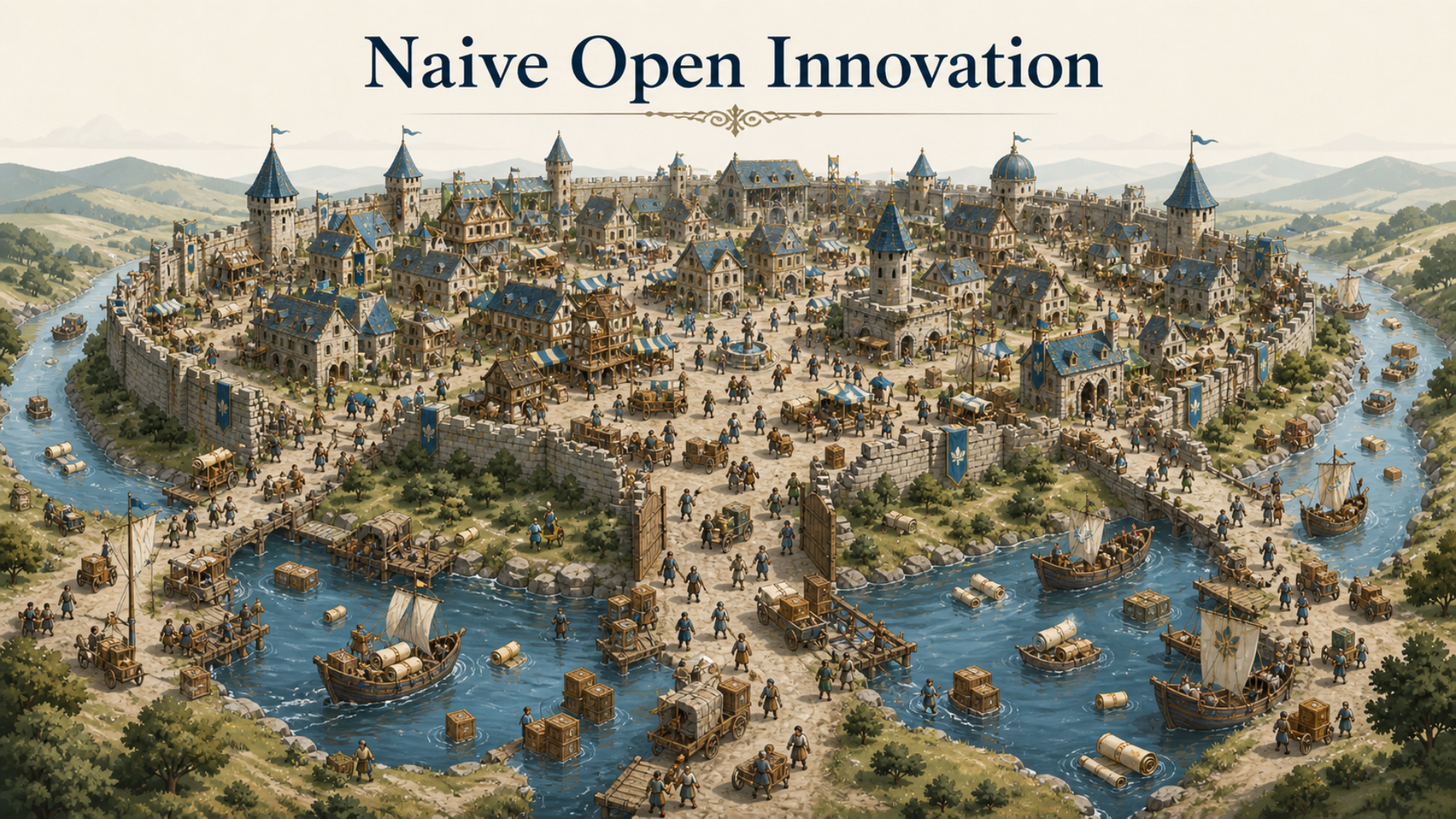
Naive openness: all gates are open, but value capture becomes unclear.
Opening every gate may look generous and easy, but it is not a strategy. It is an invitation for confusion.
Naive openness can leave you in the worst possible position: you do the work, share the knowledge, help create the value, and still lack the rights, position, or agreements to capture that value afterwards.
It often looks dynamic from the outside. There are many partners, many meetings, many ideas, and many conversations. But activity is not the same as progress.
When nobody knows who owns what, who can use which result, what can be published, what must remain confidential, and how value will be captured, the project becomes fragile.
Sooner or later, someone asks the difficult question:
Who captures the value?
And if that question has not been addressed early enough, trust can disappear very quickly.
Leadership point: closed innovation limits learning, naive openness weakens value capture. Strategic openness is the useful middle.
Strategic openness: the practical middle ground in collaborative innovation
The stronger option sits between these two extremes.
In the city metaphor, this is not a city without walls. It is a city with gates, guards, agreements, trading rules, protected spaces, and public squares. Some areas are open for exchange. Some areas require permission. Some assets stay protected. The point is not to remove the walls, but to design the access.
Strategic openness is not closed innovation with a nicer name. It is also not naive openness with a few legal documents added at the end. It is a deliberate way of designing how partners work together.
Strategic openness means you:
- Share what enables collaboration
- Protect what is strategically essential
- Define access rights early
- Choose the right protection mechanism depending on the asset: contracts, licensing, publication agreements, secrecy, patents, or a combination of these
Most importantly, you are explicit about both value creation and value capture.
That last point is often underestimated. Many innovation teams are comfortable talking about value creation. They discuss impact, outcomes, user benefits, technical results, and societal relevance.
But value capture is more sensitive.
Who may use the results? Under which conditions? In which markets? For which applications? With which rights?
Avoiding these questions may feel polite in the beginning, but it usually creates bigger problems later.
For leaders, the practical consequence is simple: do not ask your legal team to protect everything by default. First decide what the business needs to win.
That decision should be aligned with your strategy: where you want to grow, which capabilities you want to build, which markets you want to enter, and which assets truly create advantage.
Before deciding what to protect or share, it helps to clarify the value logic of the innovation itself. That is why strategic openness also starts with defining value before defining solutions.
Strategic openness is not about keeping everything secret. It is about knowing what to share, when to share it, with whom, and under which conditions.
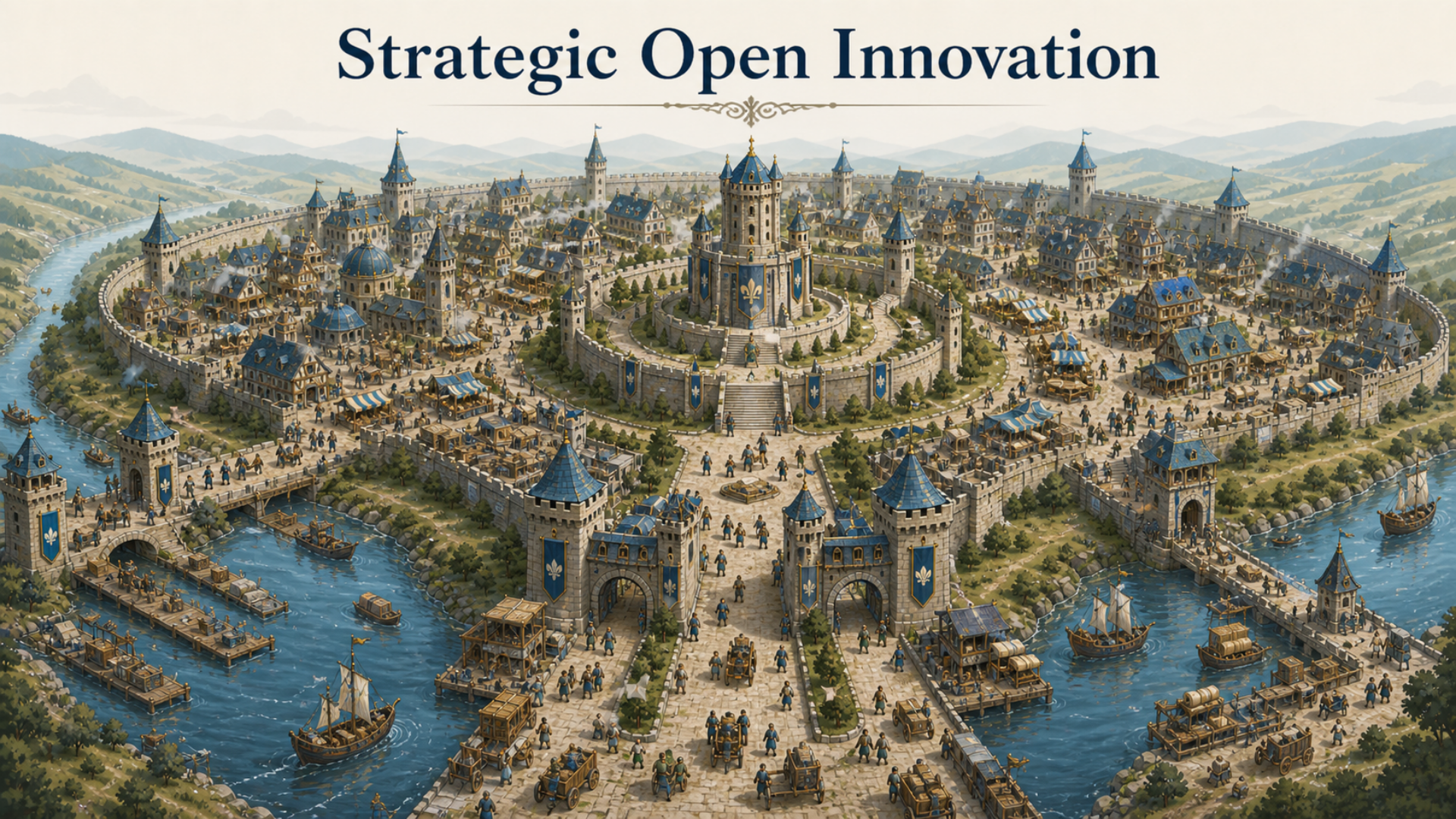
Collaborative innovation is not about opening every gate. It is about designing which gates should open, for whom, and under which conditions.
IP protection should follow strategy, not fear
Intellectual property matters. In many collaborations, it is one of the reasons companies can invest with confidence. The problem starts when IP protection stops being a strategic choice and becomes a defensive reflex.
Instead of asking:
- What do we need to protect?
- What can we safely share?
- What must partners know to contribute meaningfully?
- What results should be jointly accessible?
- What should remain partner-specific?
The discussion becomes much narrower:
How do we make sure we own everything?
That mindset often blocks collaboration before the real value has even been explored. It reduces the available collaboration space. It makes potential partners cautious. It can turn a promising co-creation opportunity into a contractual tug-of-war.
The irony is that overstressing IP can reduce the value you are trying to protect. If the project never reaches strong collaboration, no meaningful result may be created in the first place.
Good IP thinking should not kill openness. It should make openness safer, clearer, and more productive.
This is where leaders need to step back from the legal reflex and look at the business model. Whether an innovation needs strong, exclusive, and tightly secured IP is not determined by the innovation concept alone. It is determined by the market, the business model, and the route to value capture.
In biotech, for example, strong patent protection can be essential. Development cycles are long, regulatory costs are high, investment needs are substantial, and investors often need protected ownership before they commit. In that context, securing exclusive IP can be a condition for bringing the innovation to market at all.
In software, the logic can be very different. Of course, some software companies rely heavily on proprietary technology. But in many cases, speed, adoption, integration, user experience, service quality, data position, community, or ecosystem access may matter more than exclusive ownership of the code itself. Open-source models show that valuable businesses can also be built by sharing parts of the technology while capturing value through implementation, support, platforms, services, or complementary assets.
There is also a timing issue. In fast-moving software markets, the technology or architecture you try to protect may no longer be strategically relevant by the time a patent is finally granted. By then, the market may have moved, the platform may have changed, or the competitive advantage may have shifted from the code itself to adoption, data, integration, or execution speed.
That means the real IP question is not simply:
Can we protect this idea?
The better question is:
What type of protection does this market, business model, and collaboration route actually require?
Leadership point: do not protect everything by default. Protect what your market, business model, and route to value actually require.
Co-creation does not mean losing control
Another frequent misunderstanding is that co-creation means giving up control.
It does not.
Co-creation means that partners actively shape something together. Their perspectives influence the concept, the assumptions, the user context, the technical direction, and the value logic. They are not merely delivering a task. They are helping to define what the project should become.
But that does not mean all partners need unlimited access to everything.
Good co-creation needs boundaries. Not walls that block collaboration, but boundaries that make collaboration workable.
A co-creation project should clarify:
- Which knowledge is background knowledge
- Which results are developed during the project
- Who can use those results afterwards
- What can be published
- What remains confidential
- How different partners can capture value from the work
This is especially important in research-industry collaboration.
A post-doc researcher may need publication opportunities. An SME may need a marketable result. A corporate partner may need internal approval before using or sharing certain assets. A public funder may expect dissemination and broader impact.
These goals are not automatically in conflict.
But they do need to be made explicit.
This distinction also connects to the broader question of three ways organisations work together: delivery, contribution, or real collaboration.
Co-creation projects are not the same as collective projects
There is another distinction that deserves more attention: collaborative co-creation projects are not the same as collective projects.
In a collaborative co-creation project, a defined group of partners works together to create a new solution, service, process, technology, or concept. The partners need enough openness to shape the direction together. They need to understand the ambition, the assumptions, the user context, and the expected value.
But the openness is mainly organised around the collaboration between those partners.
Collective projects have a different logic.
They are often created around a broader sector challenge, a public mission, a shared infrastructure, a standard, a knowledge platform, or a funding programme that requires wide dissemination. In these projects, openness is not only a collaboration choice. It can be part of the funding logic.
That changes the conversation.
In some publicly funded or sector-wide projects, partners are expected to share insights beyond the immediate consortium. Results may need to benefit a wider field, not just the organisations around the table.
This can create real value: sector learning, faster adoption, stronger standards, shared methods, and broader innovation capacity.
But it can also create tension.
Companies may fear that the project is too open. They may worry about losing knowledge, market advantage, or control over future applications. Their reaction is understandable, but the reflex can become too defensive: protect everything, share as little as possible, and avoid any real exposure.
At the other extreme, project initiators may assume that because the project is collective or publicly funded, everything should be open to everyone. That can create the naive openness problem again: unclear ownership, vague access rights, weak value capture, and too much reliance on goodwill.
Both reactions are problematic.
A collective project does not remove the need for strategic openness. It increases it.
How to decide what should be open, shared, or protected
One of the most useful shifts is to stop treating a project as one single open-or-closed block.
In reality, different parts of the same project can require different levels of openness.
- Some insights can be public
- Some results can be shared within the consortium
- Some methods can be published
- Some datasets may need restricted access
- Some technologies may remain partner-specific
- Some outputs can be licensed
- Some early findings can be used for sector learning without exposing the full strategic core of a company
This layered view makes collaboration more realistic. It allows companies to participate without feeling exposed. It allows researchers to create and share knowledge. It allows public funders to see broader impact. It allows SMEs and corporates to explore new opportunities without giving away the assets that make them valuable.
It also supports better strategic choices. By deciding what should be open, shared, restricted, or protected, your organisation can enter the collaboration with more confidence and a clearer path towards results.
Innovation governance helps trust survive
In many collaborations, governance is seen as something heavy. Legal. Administrative. Slow. Something that comes after the creative work.
That is a mistake.
In collaborative innovation, governance is not the opposite of trust. It is what helps trust survive.
Good governance does not mean putting a legal wall around every conversation. It means agreeing early on the rules that allow people to collaborate with confidence.
Responsible collaboration does not avoid difficult questions. It addresses them early, so every partner knows where they stand.
- Who decides what?
- Who can access which information?
- What happens with background knowledge?
- What happens with foreground results?
- What can be communicated externally?
- What happens if a partner leaves?
- What is the route from shared exploration to individual exploitation?
These questions may feel uncomfortable at the start. But they are far easier to address before tensions appear.
When governance is missing, people fill the gaps with assumptions. And assumptions are dangerous in innovation projects. One partner may assume that a result can be used commercially. Another may assume that it will be published openly. A third may assume that access is limited to the consortium. A fourth may assume that sector-wide dissemination is mandatory.
Everyone may think they agree, while they are actually working with different mental contracts.
That is where disappointment starts.
The goal is not to build a fortress. The goal is to build a city where the right people can trade, learn, and grow without losing the crown jewels.
Leadership point: governance is not paperwork. It is how you prevent assumptions from destroying trust later.
From defensive IP protection to designed openness
The real challenge is not choosing between closed innovation and open innovation.
The challenge is designing the right collaboration model.
For an SME innovation manager, that may mean opening up enough to access expertise, funding, and partners, while protecting the few assets that are strategically critical.
For a corporate innovation manager, it may mean creating a collaboration structure that is open enough to validate new concepts, but clear enough to survive legal review, internal governance, and future scaling.
For a post-doc researcher, it may mean understanding how to create room for publication and scientific value, while respecting the strategic concerns of industry partners.
In all three cases, the question is not:
Should we be open or closed?
The better question is:
What kind of openness helps this project create value, and what kind of protection helps that value survive?
That is where collaborative innovation becomes practical and strategic.
It turns openness from a vague attitude into a design choice. It turns IPR from a defensive reflex into a value strategy. It turns co-creation from a feel-good word into a structured process. And it turns collective projects from mandatory openness into purposeful shared progress.
Choosing wisely does not guarantee success, but it does maximise the conditions for it. The right openness model helps partners contribute with confidence, keeps the route to value clear, and makes it more likely that the collaboration delivers stronger results and sustainable growth.
Five leadership questions before your next innovation partnership
Before entering a collaboration, it is worth taking a quiet moment to map your own position first.
Before your organisation joins or launches a collaborative innovation project or innovation partnership, decide your position on five points:
- What do we need to share so others can contribute meaningfully?
- What must we protect because it is strategically important?
- Which results do we need to use afterwards, and under which conditions?
- What value do we expect to capture: knowledge, market access, validation, funding, speed, visibility, or something else?
- Which agreements do we need before we can collaborate with confidence?
These questions do not slow down innovation. They prevent confusion, reduce fear, and help your organisation enter the collaboration with more clarity.
Do not decide openness at project level only. Decide it per asset, per partner, per market, and per route to value.
The leadership task is not to make collaboration as open as possible. It is to make openness useful, safe, and strategically aligned.
Because collaborative innovation is not the absence of boundaries.
It is the deliberate design of boundaries that make collaboration possible, valuable, and safe.
For a deeper view on how governance supports stronger partnerships, this topic connects naturally to governance in innovation collaborations.
If you recognise this tension between openness, ownership, and collaboration in your own projects, you can reach out via the contact page. I am happy to think along about what strategic openness could look like in your context.
Hey!

