
Borders are optional: how Oostende shaped my open mindset
Jul 20, 2026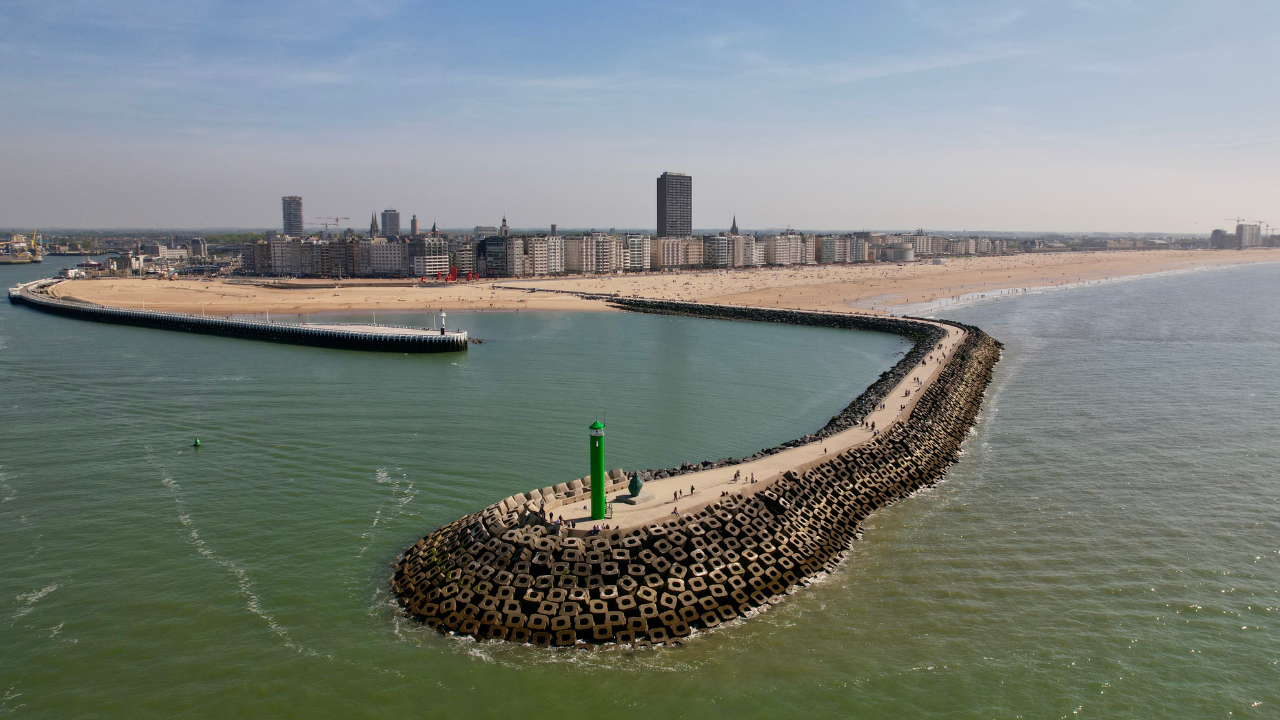
I grew up in Oostende, a harbour town that quietly teaches you a different relationship with the world.
A harbour is not just boats and fish. It is movement. It is languages. It is people coming and going with stories, habits, and viewpoints you do not find in a closed loop. Without anyone explicitly “teaching” it, you pick up something essential: the world is not far away. It is simply connected.
A harbour does not just connect ships. It connects mindsets.
The accidental BBC advantage
Here is one of those wonderfully imperfect details that ended up shaping my life.
Decades before streaming, and long before most kids in Belgium had daily exposure to English, we had BBC on our cable. Not because someone planned it, but because the technical filters were not good enough to fully block the signal at the coast, and the received signal ended up propagating through the cable.
It was a technical inefficiency with a huge upside.
Suddenly, English was not a school subject. It was a living thing in our living room. I learned to read and speak English long before school age, simply because it was present and normal.
Sometimes opportunity enters your life through a “flaw” in the system.
And it was not only language.
I still remember those BBC graphics with strange curves and functions, the kind of visuals that looked almost magical to a kid. Weather maps, science explainers, little animated diagrams that made patterns feel real. Much later I learned that some of those “mysterious shapes” were basically early encounters with what I would later call goniometrics and mathematical functions.
At the time, I did not have the words. I only had fascination.
That fascination turned maths into something friendly. Not a school hurdle, but a tool to describe the world. And later, when I went into engineering, it felt less like entering a new domain and more like continuing a story that had already started.
Before maths was a subject, it was a visual language.
Looking back, the common thread is “leakage”. Signals crossed filters, languages crossed living rooms, ideas crossed borders. And once you notice that boundaries are often leaky, you stop treating them as absolute.
Borders are great for paperwork. They are less useful for opportunity.
International shopping before it was trendy
My parents also had a habit that, in hindsight, was a mindset training program.
International shopping trips were normal. Taking the ferry to Dover to buy things that were cheaper due to currency exchange was simply part of the landscape. It was also a family ritual: early departure, the excitement of “going abroad”, and the small surprises in shops that did not look like home. At the time, I did not think of it as “being international”. It was just what you did when you were curious, practical, and open.
That habit does something subtle: it normalises alternatives.
Different products. Different packaging. Different ways of doing things. Different expectations. You learn that your local default is not the only default.
And once that door opens, it rarely closes again.
When alternatives become normal, your thinking becomes less boxed in.
A mindset exercise that makes your world bigger
There is one small exercise I have used for years to keep that harbour mindset alive. I even trained my kids to look at the world this way, because it quietly creates more opportunities within reach.
It is simple:
Stop measuring distance in kilometres. Start measuring it in time.
Ask yourself: what is “one hour away”?
Because “one hour away” is not one thing. One hour by foot is a small world. One hour by bike already stretches it. One hour on local roads opens a region. One hour on the highway changes your weekend. One hour on a high speed train turns countries into neighbours. One hour by plane and your reference frame flips completely.
Same clock. Completely different world.
And here is a very concrete example I still like to use: when I was young, Oostende to Dover was a serious trip. The ferry alone was a four hour journey, one way. Today, you can reach Dover in roughly one and a half hour by car via the Channel tunnel. Same destination, completely different mental distance.
That is exactly the point: the “size” of your world is often a function of connection, not geography.
If you want to try the exercise right away, finish these sentences for your own context:
- One hour by foot gives me…
- One hour by bike gives me…
- One hour by car gives me…
- One hour by train gives me…
- One hour by plane gives me…
With my kids, it became a fun game: “what becomes possible within one hour today?” You could see their world expanding as they started spotting options instead of limits.
Once you start thinking like this, the map changes. The other side of the city might be “far” in kilometres, yet closer in time than a village next door with bad connections. Lille stops feeling like “abroad” and becomes “reachable”. Brussels and Paris are not distant capitals, they become places that are one good connection away.
And that mindset was reinforced in a very concrete way in our region: we received commercial leaflets from French supermarkets in Dutch, with prices in Belgian francs, long before the euro integration made cross border purchasing feel mainstream. Borders were present on the map, but less present in daily life.
Borders look solid on paper, but they are often porous in practice.
Why city borders still feel strange to me
This is also why, even today, I sometimes feel a bit puzzled when innovation ecosystems or political narratives obsess over city boundaries as if they are the natural unit of collaboration.
To be fair, city focus can be a practical coordination tool for funding, talent, and visibility. But from a harbour mindset, it can still feel oddly narrow, as if opportunity should stop at an administrative line on a map.
When you grow up with signals, ferries, leaflets, languages, and travellers constantly crossing borders, you start to assume that value flows where connections exist, not where borders are drawn.
That does not mean every collaboration is easy. It means the default question changes from “is this within our perimeter?” to “is there a connection worth exploring?”
Value flows where connections exist, not where borders are drawn.
What this means for innovation and collaboration
If you work in innovation, you have probably seen a modern version of the “border illusion”.
Not geographic borders, but organisational ones:
- “We cannot work with them, they are in a different sector.”
- “That partner is too far from our domain.”
- “We are not ready to collaborate internationally.”
- “That is not how we do things here.”
Sometimes these statements are valid constraints. Often they are mental shortcuts that feel safe.
The harbour mindset pushes back on that reflex. It invites a different question:
What if the real distance is not organisational, but relational?
Not “are they in our industry?”, but “can we build trust quickly?” Not “are they nearby?”, but “can we align fast and work well together?” Not “do we share the same system?”, but “can we translate expectations?”
This is where open innovation becomes real. The best collaborations do not start with a contract. They start with an open mindset that assumes bridges are possible, and then does the work to make them practical.
When teams adopt that mindset, the impact is tangible: faster partner discovery, quicker validation loops, stronger collaboration choices, and innovation outcomes that are more likely to translate into growth rather than isolated experiments.
If you want a practical anchor for this: it is the same idea as defining value before defining solutions. When you get clear on the value you want to create, you stop rejecting opportunities based on labels and start exploring them based on fit.
The biggest constraint in innovation is rarely the border. It is the belief that the border cannot be crossed.
A small practice to unlock a bigger world
If you want to test this mindset in your next project, try one simple exercise.
List three “borders” around your innovation effort:
- a partner type you assume is out of reach
- a region you assume is too far
- a capability you assume you have to build alone
Then add one extra question before you dismiss any of them:
Why not?
Or, even more practical:
What is the worst that can happen if we explore this for a bit?
That question does not force a yes. It simply creates enough space to test assumptions instead of protecting them.
Before you say no, ask: why not, and what is the worst that can happen if we explore it?
Then rewrite each “border” as a time and effort question:
- “How many conversations would it take to see if this is viable?”
- “What would make this reachable within 90 days?”
- “Who could shorten the learning curve if we collaborate?”
Try this once this week: pick one border you would normally accept, ask “why not?”, and run a single low effort conversation. You might discover that what felt like a hard no was simply a no you never tested.
This shifts the discussion from “no” to “how”. Not naive optimism, but practical openness, and it often leads to better decisions, more collaboration momentum, and more results over time.
If you are curious how this mindset could help widen opportunities in your own innovation projects, feel free to reach out via the contact page. I am happy to think along with you.
Hey!

