
Beyond SMART Goals: Why Innovation Needs Target Conditions
Aug 10, 2026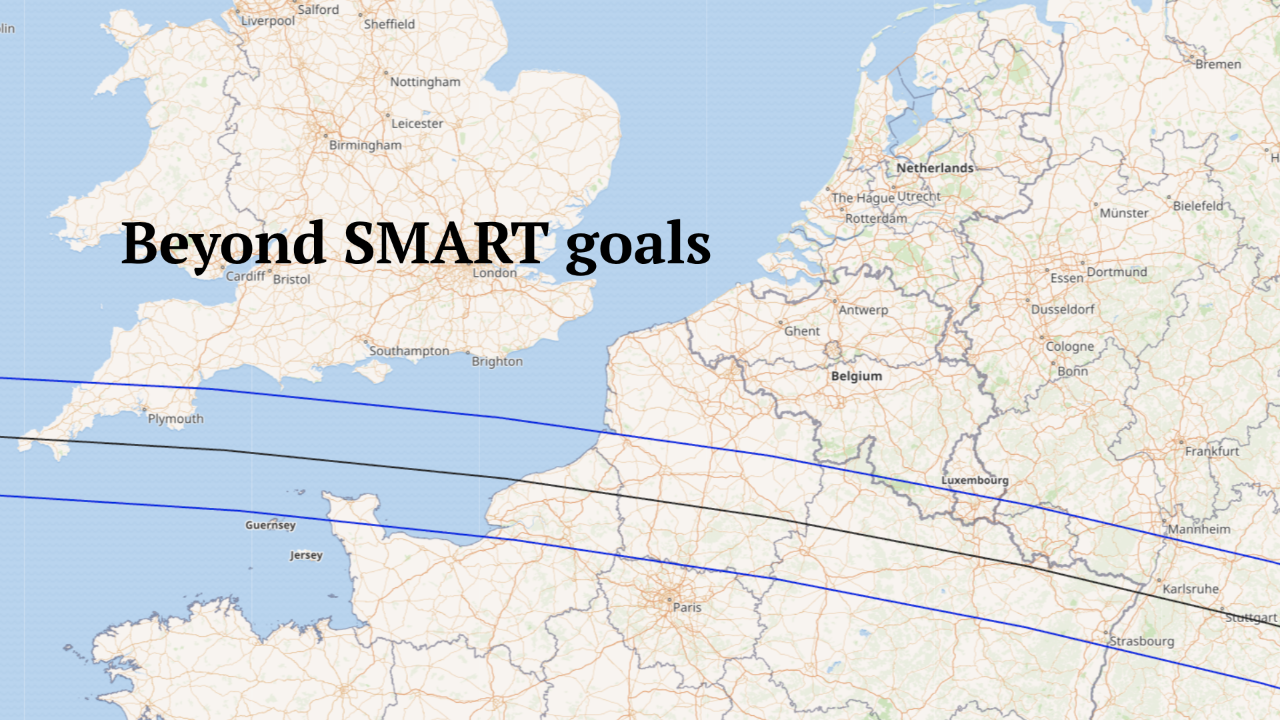
On 11 August 1999, Belgium stood still for a once in a lifetime event: a full solar eclipse.
The media had been building anticipation for weeks. Everyone seemed to know where to go. Virton, the only Belgian city close to the central line of the eclipse path, quickly became the place to be. Thousands of people headed in that direction, convinced that this was the best possible location to experience the event.
And of course, that created exactly what you would expect: traffic jams, crowds and a lot of people trying to reach the same ideal point.
Our family chose a different approach.
Not because we were better prepared, but because we were prepared differently. I took out a paper map, this was long before Google Maps became part of daily life, and traced three lines. The central path of the eclipse, and the outer boundaries where the full experience would still be visible.
Instead of defining one perfect destination, we defined a target zone.
The goal was clear: reach the eclipse area, stay as close as reasonably possible to the central line, and avoid the chaos.
So we took smaller roads. My wife navigated. We followed the map, adjusted along the way, and eventually found a quiet hilltop parking lot in northern France. It had a clear 360 degree view, enough space for a picnic and exactly the calm excitement you hope for when waiting for something extraordinary.
And then came the bonus we had not planned.
A VW van pulled up next to us. Another family stepped out. They had brought a massive telescope and projected the sun safely onto a screen. Our children could see the gradual bite of the shadow, and even sunspots.
It turned a well planned family outing into a shared moment of wonder, the kind of moment that stays in a family story long after the practical details fade.
The eclipse itself was unforgettable. Day turned into twilight. The horizon glowed all around us. A strange silence fell over the fields. But what made the memory even stronger was not just the event itself. It was the way we experienced it.
We had a clear goal, but not a rigid route.
We had boundaries, but not a fixed point.
We had prepared enough to succeed, while leaving room for something better than we could have planned.
That is why I often question how we use SMART goals in innovation. Not because the framework is wrong, but because innovation needs a different kind of clarity before it needs measurable execution targets.
The innovation lesson hidden in the eclipse story
This story keeps coming back to me when I work with innovation teams, research groups and collaboration consortia.
Many teams start innovation projects with the right intention: create clarity, define the goal and make progress measurable. That is understandable. Nobody wants an innovation project that drifts endlessly without result.
So the SMART goal framework often enters the room.
Specific. Measurable. Achievable. Relevant. Time based.
There is nothing wrong with SMART goals. They are useful, especially when a project moves into execution. Once the direction is clear and the work needs to be organised, SMART goals help teams stay focused, monitor progress and avoid vague commitments.
The problem starts when SMART goals are used too early.
In the early stages of innovation, collaboration and consortium building, being too specific can close the space before partners have had the chance to explore it together. It can push everyone toward one exact Virton, one fixed destination, one predefined answer.
And when everyone is pushed toward the same narrow target, innovation traffic jams appear.
Sometimes your SMART goal is just everyone else’s traffic jam.
Partners start optimising for the written goal instead of exploring the real opportunity. Alternative routes are ignored. Unexpected contributions are filtered out because they do not fit the original wording. The project becomes measurable before it becomes meaningful.
That is risky.
The practical question is not only how to set innovation goals, but how to set them at the right level of precision.
Innovation rarely behaves like a straight road to a fixed point. It behaves more like a landscape. You need direction, but you also need room to navigate.
Why early innovation needs target conditions
In the eclipse story, the goal was not vague. We were not simply going somewhere to maybe see something. The target was clear enough to guide decisions.
We needed to be inside the eclipse zone.
We wanted to be reasonably close to the central line.
We wanted to avoid the main traffic.
We needed a location with visibility.
That combination created what I would call target conditions.
Target conditions are the essential boundaries, success criteria and degrees of freedom that help an innovation project move forward without locking it into one premature solution.
They are not the same as loose ambitions. They are not an excuse for poor planning. They define the space in which a project can succeed.
For innovation teams, this is powerful.
Instead of immediately saying, “This is exactly what we will build, for this exact user, with this exact partner, by this exact date,” early stage innovation can start with a more useful question:
What conditions must be true for this collaboration to create value?
That question opens better conversations.
For an SME innovation manager, it can help avoid months of work on an overdefined pilot that no partner can realistically support. For a corporate innovation manager, it can prevent internal alignment sessions from turning into approval theatre. For a postdoctoral researcher, it can help translate scientific ambition into a collaboration space where industry partners see value without reducing the research to a simple service request.
Target conditions create enough structure to move forward, while keeping enough openness to discover stronger routes. This increases the chance that innovation work leads to stronger concepts, better partner engagement and more valuable growth.
Why rigid innovation goals create traffic jams
Innovation leaders often want clarity, and rightly so. Teams need direction. Partners need to understand what they are contributing to. Funders and executives need confidence that the project will produce results.
But clarity and rigidity are not the same thing.
Clarity means people understand the ambition, the boundaries and the logic of the project.
Rigidity means people are no longer allowed to learn.
That is where early SMART goals can become counterproductive. They can make a project look professional while reducing its ability to adapt.
Think of an innovation consortium at the proposal stage. The lead partner defines a very specific solution too early. Work packages are built around that solution. Partners are invited to contribute to predefined tasks. On paper, everything looks organised.
But what if one partner sees a better application?
What if the user need is slightly different from what the technical team assumed?
What if the strongest value is not in the first solution, but in an adjacent opportunity?
What if a research partner can open a route that was not visible at the start?
If the project has been defined too tightly, these opportunities feel like deviations. If the project has been defined through target conditions, they become part of the exploration.
This is the difference between controlling innovation and enabling it.
Clarity helps innovation. Rigidity stops it from learning.
Use must haves, nice to haves and no goes
One practical way to define target conditions is to work with three categories: must haves, nice to haves and no goes.
The must haves describe the essential conditions for success. Without them, the collaboration no longer creates the value it is meant to create.
The nice to haves describe the space for enrichment. These are opportunities that could make the project stronger, more attractive or more scalable, but they should not block the collaboration if they are not available.
The no goes define the boundaries. They protect the project from drifting into areas that are strategically, ethically, technically or commercially unacceptable.
This sounds simple, but it changes the quality of the conversation.
Instead of asking partners to agree on one fixed end point, you invite them to make their expectations explicit. What do they really need from the project? Where can they be flexible? What would make the collaboration irrelevant for them?
That conversation is essential in Win Winnovation.
Strong partnerships do not require identical goals. They require aligned goals. Each partner may have a different reason to join, but the collaboration only works if those reasons overlap in a meaningful way. That is why strong collaboration needs alignment by design, not forced agreement.
The eclipse example makes this tangible. We did not need the exact same destination as the thousands going to Virton. We needed the same phenomenon, within the same zone, under good viewing conditions. That was enough to create a successful experience, and it allowed room for a better route.
Leave room for unexpected innovation value
The most memorable part of the eclipse story was not on the map.
It was the telescope.
We had not planned for it. We had not listed it as a requirement. We had not made it measurable. Yet it enriched the experience enormously.
This is also true in innovation.
Some of the most valuable outcomes in collaboration come from what you did not plan, but made possible.
A partner brings an unexpected insight.
A user reframes the problem.
A researcher spots a hidden mechanism.
A supplier proposes a simpler way to test the concept.
A stakeholder raises a concern early enough to prevent failure later.
These moments are often where innovation becomes stronger. They turn a project from acceptable into valuable. They help transform ambition into concrete ideas, stronger processes and engaged partnerships that lead to better results and growth.
But they only happen when the collaboration design allows them to happen.
If the plan is too rigid, surprises are treated as disturbances.
If the target conditions are well designed, surprises become assets.
Innovation thrives on target conditions, not rigid destinations.
When SMART goals do help innovation
This is not a plea to abandon SMART goals.
It is a plea to use them at the right moment.
SMART goals are excellent for execution, but risky for exploration.
In the early phase of innovation, you need alignment, exploration and shared understanding. You need to define the collaboration space before you define the exact project plan.
Later, when the concept has matured and the partners understand the value they want to create together, SMART goals become useful. They help translate the chosen route into action. They create accountability. They make execution manageable.
The sequence matters.
First create the conditions.
Then define the plan.
Then make execution measurable.
In a strong innovation management system, strategy gives innovation direction before execution becomes measurable.
When you reverse that order, you risk making the wrong thing measurable too early.
Make the collaboration space clear before you make the execution measurable.
A quick check before you make your goals SMART
If you are working on an innovation roadmap, a research industry collaboration or a new consortium, it may be worth asking three simple questions before you lock the project into SMART goals.
1. Are we defining a target zone or forcing everyone toward one fixed point?
A strong target zone gives direction without closing the exploration too early.
2. Have we made the boundaries explicit?
Creativity works better when people understand the limits. Good boundaries do not suffocate innovation. They protect the space in which it can grow.
3. What kind of surprise are we willing to welcome?
If there is no room for unexpected insights, there may be no room for real innovation.
These questions are simple, but they can save a team from a lot of false certainty. They help you move from premature control to practical alignment.
From perfect control to better innovation conditions
The 1999 eclipse was a lesson in preparation, but not in overcontrol.
We did not reach the famous destination. We avoided the traffic. We found a quiet place. We experienced the eclipse beautifully. And because we had not overdefined the plan, we also benefited from an unexpected telescope moment.
That is often how innovation works.
The best results do not always come from the most detailed plan. They come from the best conditions: clear direction, smart boundaries, engaged partners and enough openness to discover what you did not know at the start.
So the next time your team starts defining innovation goals, pause before making everything SMART.
Ask whether you are chasing your own Virton.
Maybe the stronger opportunity is not in the crowded centre of the map.
Maybe it is on a quiet hilltop, inside the right zone, with room for discovery.
If this resonates with your own innovation challenges and you want to translate it into a practical approach, you can contact me through the contact page. I am happy to think along with you.
Hey!

